











Samsung Bioepis’ Keytruda biosimilar demonstrates equivalence in global Phase 3 trial
 0
 0

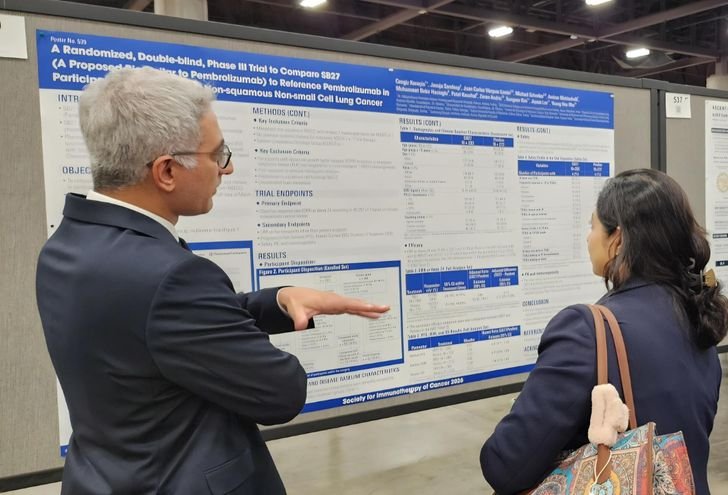
A Samsung Bioepis official, left, explains the global Phase 3 clinical trial result of SB27 at the Society for Immunotherapy of Cancer Annual Meeting 2026 in Phoenix, Ariz., Nov. 6. Courtesy of Samsung Bioepis
Samsung Bioepis said Monday that its proposed biosimilar SB27 demonstrated comparable efficacy and safety to Keytruda, a blockbuster cancer immunotherapy drug that was the world’s best-selling pharmaceutical product last year, in a global Phase 3 clinical trial.
According to the company, it announced the Phase 3 clinical study results at the Society for Immunotherapy of Cancer Annual Meeting 2026 held in Phoenix, Arizona, from Nov. 4 to 8.
Keytruda, developed by U.S. pharmaceutical company MSD, is a cancer immunotherapy drug that binds to programmed cell death protein 1 (PD-1), an immune checkpoint receptor, helping the immune system attack cancer cells. It was the world’s best-selling drug last year, generating approximately 46 trillion won ($31.7 billion) in global sales.
The Phase 3 study, which began in 2024, involved 555 patients with metastatic nonsquamous non-small cell lung cancer across 14 countries, comparing SB27 with the original drug in combination with standard chemotherapy.
In the study, SB27 met its primary endpoint by demonstrating an equivalent objective response rate to the original drug at Week 24.
SB27 also showed comparable results in progression-free survival, duration of response and overall survival. Its safety profile was similar to that of the original drug, with comparable rates of treatment-emergent adverse events and serious adverse events. No neutralizing antibodies, which can reduce a drug’s effectiveness, were detected.
Samsung Bioepis filed for regulatory approval of SB27 with Korea’s Ministry of Food and Drug Safety in August, becoming the first company to seek approval for a Keytruda biosimilar in Korea.
It also submitted an application to the U.S. Food and Drug Administration in October. The company plans to complete regulatory approval procedures in each market as quickly as possible to ensure a timely global launch.
Keytruda’s key patents are scheduled to expire in Korea and the U.S. in 2028. By securing Phase 3 clinical data and filing for regulatory approval in both countries, Samsung Bioepis is expected to gain a competitive edge in entering the biosimilar market early.
“Oncology remains an important area of focus for Samsung Bioepis, and the development of SB27 reflects our continued commitment to advancing high-quality biosimilar medicines,” Samsung Bioepis Executive Vice President Shin Dong-hoon said.
“We aim to establish a robust clinical evidence base to support the development of a potential biosimilar treatment option for oncology patients worldwide.”