









Filmmaker Lee Chang-dong finds poetry in fight of the powerless individual
 0
 0
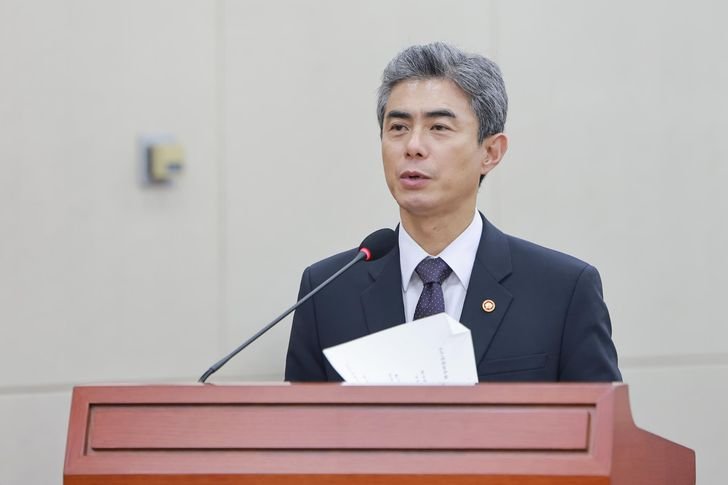
Lee Chang-dong / Courtesy of Netflix
“‘Possible’ and ‘love’ are both commonly used words, but when they came together, the combination felt unfamiliar. I wondered, ‘What kind of love is possible?’ I thought the title would pose a question to audiences and prompt them to reflect on the nature of love.”
The title “Possible Love” sparks curiosity before the film and leaves audiences with a peculiar sense of sadness afterward. It emerged from this very idea, according to director Lee Chang-dong, whose seventh feature film marks his return to the big screen after an eight-year hiatus. The Hankook Ilbo met Lee at a cafe in central Seoul on Friday, the day Netflix, the film’s investor and distributor, released it worldwide.
As its title suggests, the film explores several intertwined layers of love. It follows the events that unfold when Ho-seok (Sol Kyung-gu), a laid-off worker, and his wife Mi-ok (Jeon Do-yeon) encounter Ye-ji (Cho Yeo-jeong), an affluent documentary filmmaker who films their lives, and her husband Sang-woo (Zo In-sung). Issues of labor, class and the ethics of artistic creation overlap on multiple levels. Lee spoke about three forms of love running through the story.
The first is Ye-ji’s love. When Sang-woo remarks that Ye-ji is “method acting,” as though there were no class divide between her and Mi-ok’s family, she responds almost like a vow: “I will try to love them.” Yet it remains unclear whether she genuinely wants to understand their lives or exploit them for her film.
“For anyone who creates work based on other people’s stories, at least making an effort to love the people they portray is important. Whether that love is actually possible is another question,” Lee said.
A scene from “Possible Love” / Courtesy of Netflix
Ye-ji’s camera relentlessly probes their suffering, but it also reveals the faint possibility of solidarity. Her presence, for instance, prompts Mi-ok to consider forming a labor union, something she had only contemplated before, while encouraging Ho-seok to open up about his innermost feelings.
Another form of love emerges in the ambiguous attraction between Mi-ok and Sang-woo. When they are alone in a car, Sang-woo tells her, “I’m happy we’re together.” Later, by the seaside, he brushes the dirt off her knee, stirring her emotions.
“Sang-woo, who makes everyone like him, resembles capital in its nature,” Lee said. “But I also hope audiences will consider the fact that Mi-ok resists this romance, which could potentially even save her life.”
Sang-woo represents capital, while Mi-ok symbolizes the working class. The precarious tension between them reaches its peak toward the end of the film.
The final form of love is that shared by Mi-ok and her husband, who met in their hometown as teenagers and have weathered life’s ups and downs together.
“It’s a love in which two people affirm each other’s worth simply by being there for one another, and find a reason to keep living. I think this may be a form of love that is unquestionably possible,” Lee said.
A poster for “Possible Love” / Courtesy of Netflixt
Why tell a story of love through a laid-off worker?
Why did Lee choose to explore love through the story of a laid-off worker in particular?
The director first conceived the film after being deeply shaken by the mass layoffs at Ssangyong Motor in 2009.
“It seemed like an event that effectively formalized the disregard for the value of labor and workers’ rights, which had been taken for granted throughout human history, while declaring the logic of capital more important,” he said.
Uncertain about the film at the time, Lee halted production. It took him 16 years to complete “Possible Love.”
Throughout his career, Lee has confronted uncomfortable realities: people displaced by urbanization in “Green Fish” (1997), lives shattered by state violence in “Peppermint Candy” (1999) and a young man trapped in helplessness and rage in “Burning” (2018). His exploration of neoliberalism and the disappearance of labor may therefore have been inevitable.
Through Mi-ok, Lee delivers an intensely detailed portrayal of human dignity and vitality in the face of capital.
“I believe that in this day and age, the struggle of a powerless individual to prove the meaning of their own life is a meaningful story to tell,” he said.
“Possible Love” won the Silver Lion Grand Jury Prize, the second-highest award, at the Venice International Film Festival in September. Acclaim from critics and the media, both in Korea and abroad, has continued, with the film also winning the International Federation of Film Critics Prize and Best Picture at the Korean Association of Film Critics Awards. Expectations are growing that it could receive recognition at next March’s Academy Awards.
It would be Lee’s second Oscar campaign following “Burning.”
“There’s a distorted perception of our chances because of the success of ‘Parasite,’ which won four Oscars in 2020. But it will be difficult to see another success on that scale,” Lee said. “The barriers facing Korean films at the Academy Awards remain high. Nevertheless, we’re prepared to give it our best shot.”
This article from the Hankook Ilbo, the sister publication of The Korea Times, is translated by a generative AI system and edited by The Korea Times.