 0
0
 0
0 Actgeo ‘East Sea Oil and Gas’ Explained… Presentation of analysis process and basis for estimation of reserves
Has the credibility and qualification controversy been resolved…”Realm of interpretation, difficult to verify” argument
“Securing experts, carrying out a number of deep-sea projects” vs. “Analyzing small businesses, controversial
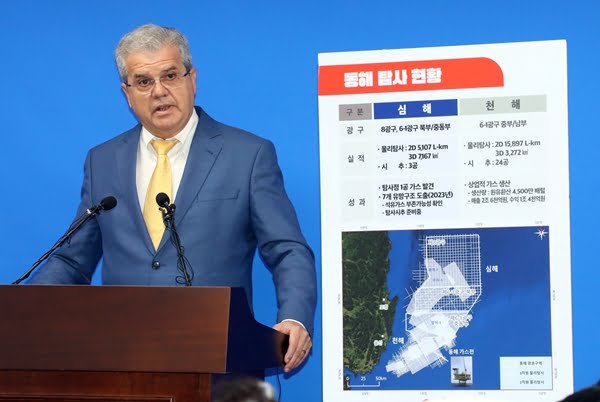
(Sejong = Yonhap News) Vitor Abreu, an advisor to Act-Geo in the United States, who was in charge of analyzing deep-sea oil and gas deposits in the East Sea, held a briefing at the Sejong Government Office on the 7th and explained various questions, and it is interesting to see if the controversy surrounding the announcement will be resolved.
Upon entering the country on Dec. 5, Abreu said, “I personally visited South Korea to give a clear answer.”
At the official briefing on the same day, he explained in relative detail the background of the estimate of up to 14 billion barrels of oil and gas reserves, the method of evaluation and analysis, and the so-called “qualification controversy” that has been raised regarding him and the company.
However, some believe that the specific method of analyzing oil and gas reserves and the basis for judging the “20% success rate” require professional verification and are basically “areas of interpretation,” so this controversy will not be easily subsided.
Abreu is the founder and owner of ActGeo and was introduced as an “advisor” at the press conference.
◇ Explanation of the process of deriving ‘up to 14 billion barrels’…”Difficult to verify due to the realm of interpretation”
“In summary, the project has a highly promising,” Abreu said at the briefing, explaining the process of taking over the data from the Korea National Oil Corporation and analyzing it.
As the government announced, the success rate of oil and gas development was 20 percent, saying, “This is a very good and high-level possibility.”
He also noted that the Liza project in Guyana, which has the largest reserves of any oil well discovered in the last 20-25 years, had a 16 percent chance of success.
He said that this conclusion was based on the fact that the four essential conditions that suggest the existence of oil and gas—reservoir (sand), cover rock (mud), bedrock, and traps—were identified in all the fields analyzed.
Oil and gas on the seabed move along the terrain and begin to accumulate when it encounters a reservoir of sand.
At this time, mud and rock salt act as a cover rock and form a structure (trap) that traps oil and gas to prevent them from escaping, and such a structure has been confirmed in the deep sea of the East Sea.
He said that he formed two teams within ActGeo to try to derive a “promising structure” that is likely to contain oil and gas, and intensively analyzed data from three wells that had previously been drilled but failed to discover oil and gas, and “found “the existence of a reservoir on a larger scale than previously anticipated.”
Through this process, seven promising structures were identified, and the reserves were estimated at 3.5 billion to 14 billion barrels after risk and reserve analysis, he explained.
Regarding the wide range of estimated reserves, he said, “This is because there are uncertainties, such as the inability to find accumulation of hydrocarbons in existing wells,” and “the maximum estimate takes into account the possibility that there are sufficient voids in the “rocks and contain sufficient amounts of oil and gas.”
However, he said, “’20 percent chance of success’ means ’80 percent chance of failure,’ and the only way to prove it is to drill.”
Commenting on the announcement, experts said, “We respect the content of the announcement,” but added, “Basically, oil and gas exploration and excavation are not in the realm of science that can be accurately quantified, so it is difficult to say right or wrong about the success rate of development.”
Experts believe that the interpretation of the “20 percent success rate” is also a matter of whether the government pursues it with the will to pursue it or whether it gives up on the risk of being too great, and it is not a matter of right or wrong.
Shin Chang-so, a professor emeritus at Seoul National University who is recognized as a world-class expert in the field of oil exploration, said, “I hope that this project will be successful as announced by the government,” adding, “It “It would be good if we could go through an additional verification process involving experienced experts and well-known overseas rating agencies to increase the probability of success.”
◇ Professionalism controversy actively clarified… “Controversy over entrusting analysis to small companies”
In response to a question about the ‘expertise controversy’ surrounding him and Actgeo, Abreu cited his past experience in large-scale projects and examples of collaboration with experts.
Actgeo is facing doubts about its credibility and professionalism as the address of its headquarters in Houston, Texas, United States, has been searched as a regular residence.
He said, “The address of the US headquarters is my home,” and “ActGeo is a consulting company, and it is the base of the consultant.”
However, he replied to the effect that due to changes in the structure of the oil industry, the experts concerned were dispersed to carry out the project.
For example, ActGeo has a talent pool around the world that includes experts in geosciences (New Zealand), seismic processing groups (Brazil), geochemistry experts (Mexico), and reservoir modeling experts (Switzerland).
In the past year, he has conducted deep-sea assessments in Myanmar, worked with Argentina’s national oil company, and worked on deep-sea projects in Brazil, Bolivia, Pakistan and Kazakhstan.
He said it’s “common in this industry” for small consulting firms to analyze big projects.
Regarding Actgeo’s decision to analyze the project, the National Oil Corporation said, “We conducted a competitive bidding for four companies and selected them fairly based on the results of technology and price evaluation.”
The oil corporation cited “confidentiality” as the reason why it did not entrust the analysis to several companies but to only one company, ActGeo.
One expert, who requested anonymity, said: “Not necessarily. Normally, they sign a non-disclosure agreement and if they violate it, they claim huge damages, and they ask various places to analyze it.”
The expert argued that “there are some leading global companies with large headquarters and large human resources, and there may be a debate about the appropriateness of entrusting a small consulting firm to do the analysis.”


