







Korea launches 3,600-ton submarine, boosting naval deterrence, defense export capacity
 0
 0

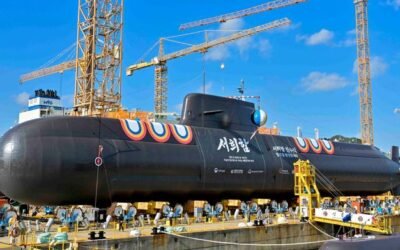
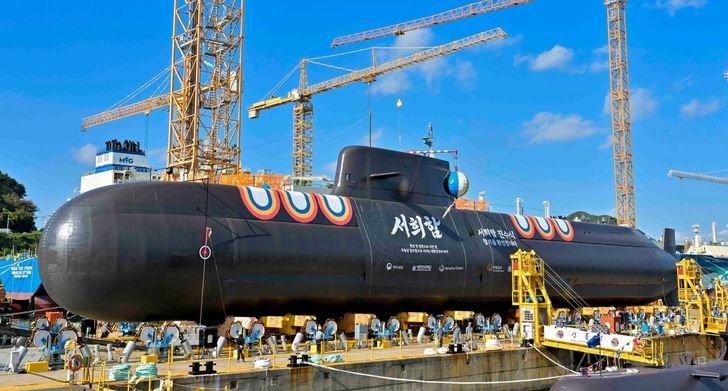
The Seo Hui, the Navy’s second 3,600-ton diesel-electric submarine, sits at Hanwha Ocean’s Okpo shipyard on Geoje Island, South Gyeongsang Province, ahead of its launch ceremony on Tuesday. Courtesy of Defense Acquisition Program Administration
Korea’s Navy and Defense Acquisition Program Administration (DAPA) launched the Seo Hui (SS-088), the nation’s second 3,600-ton Dosan Ahn Changho-class Batch-II diesel-electric attack submarine, during a ceremony at Hanwha Ocean’s Geoje Okpo Shipyard on Tuesday.
The vessel is named after Seo Hui (942–998), a prominent diplomat and statesman of the Goryeo Dynasty renowned for using strategic negotiation to fend off a massive invasion by the Khitan-led Liao Empire in 993, securing vital territory along the northwestern border without shedding blood. Navigating regional security threats around the peninsula, Korea designated his name to symbolize military foresight, national crisis resolution and maritime sovereignty defense.
The ceremony was attended by around 200 officials, including National Assembly Speaker Cho Jeong-sik. Following naval tradition, Cho’s wife, Cho Mi-seon, cut the launching ribbon attached to the vessel, symbolizing new life breathed into the newly built warship, followed by a ceremonial champagne bottle break against the hull.
Measuring 89 meters in length, the 3,600-ton Seo Hui is the second vessel under the KSS-III (Dosan Ahn Changho-class) Batch-II program, following the lead ship Jang Yeong-sil (SS-087). It represents a significant upgrade over the earlier 3,000-ton Batch-I submarines (Dosan Ahn Changho, An Mu and Shin Chae-ho). Equipped with an advanced combat management system, enhanced sonar suites and vertical launch system cells capable of firing both submarine-launched ballistic missiles and cruise missiles, the Seo Hui offers expanded multitarget precision attack capabilities and improved underwater survivability.
A defining feature of the Seo Hui is its locally developed lithium-ion battery system, paired with an Air-Independent Propulsion framework. Compared to traditional lead-acid batteries, the lithium-ion power plant significantly extends underwater endurance and high-speed operation times. To ensure operational safety, the system underwent multilayered safety design verifications and land-based test facility evaluations before deployment, according to DAPA.
The submarine also incorporates 70 domestically produced systems — adding 12 new localized components beyond Batch-I — achieving high indigenous content. This substantial localization guarantees efficient follow-on logistical support and strengthens Korea’s competitive edge in the global defense export market for K-submarines.
“The Seo Hui is a world-class diesel submarine that integrates state-of-the-art technology, serving as a meaningful milestone that demonstrates the excellence of Korea’s domestic submarine design and construction capabilities,” said Lee Sang-woo, head of DAPA’s Nuclear-Powered Submarine Project Group. “Building on our expanded localization achievements, we expect this submarine to not only reinforce the Navy’s combat readiness, but also contribute significantly to establishing a foundation for the advanced defense industry and boosting submarine exports.”
“The Seo Hui is a cutting-edge national strategic asset capable of responding effectively to security threats based on its formidable underwater operational capabilities,” said Rear Adm. Lee Koo-sung, director general for planning and management at Navy Headquarters. “We will continue to build up naval power based on advanced science and technology to fulfill our mission as an elite navy protecting the public.”
Following extensive sea trials, the Seo Hui is scheduled for delivery to the Navy in 2028 before entering full operational deployment.
This article was published with the assistance of generative AI and edited by The Korea Times.