











AI-assisted songs storm Korean music charts
 0
0  0
0 
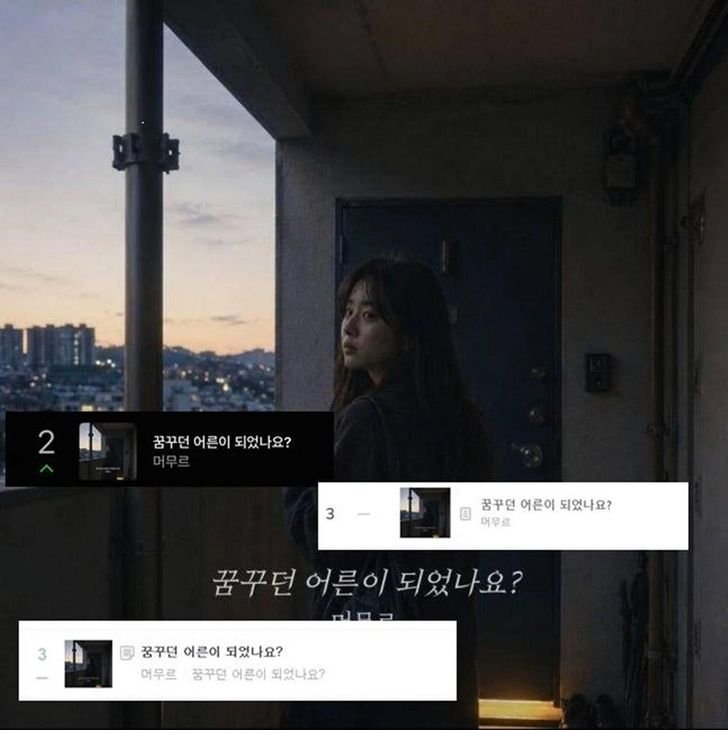
“Have You Become the Adult You Dreamed of?” by Meomuru / Captured from YouTube
Artificial intelligence (AI)-assisted music, which spread rapidly through short-form videos and YouTube just a few months ago, has now broken into the upper reaches of major Korean music charts. As songs not sung by actual human vocalists compete alongside established artists, debate over AI music is intensifying.
As of Wednesday, “Have You Become the Adult You Dreamed of?” by Meomuru ranked No. 3 on Melon’s TOP100 chart. The song also reached No. 2 on Genie Music and YouTube Music, placing it near the top of major streaming platforms.
Released in June, the track gradually gained word-of-mouth popularity. As recently as early October, it remained as among the top 20 songs on Melon’s TOP100 before climbing rapidly. Its rise suggests that online buzz is translating into actual music consumption.
A rock ballad, “Have You Become the Adult You Dreamed of?” explores the gap between the person one dreamed of becoming as a child and the reality of adulthood, along with the worries that accumulate over time. What makes the song particularly striking is that its emotionally expressive vocals do not belong to a human singer.
Meomuru used Suno, a generative AI music platform, for the song’s vocals. However, AI did not automatically handle the entire production process. Meomuru wrote the lyrics and oversaw the concept and overall production direction, using AI as a tool to bring the musical vision to life.
This approach has brought the debate over AI music back into the spotlight.
Some listeners argue that the quality of a song and its ability to convey emotion matter more than whether AI was involved, while others say they continued listening without realizing it was AI-generated. Others, however, worry that AI-produced music occupying major charts could eventually displace established singers and human creators.
One particularly interesting aspect is that many listeners discover only afterward that the vocals were generated by AI. Rather than seeking out the song because it is labeled AI music, they consume it much like any other track and learn about its production method later.
This reflects a broader pattern in AI music consumption over the past several months.
“GG EZ” by M. Sasuke, released in May, also spread rapidly through TikTok, Instagram Reels and YouTube Shorts. Numerous K-pop idols, including Sion and Riku of NCT WISH, Shotaro of RIIZE, Kyungmin of TWS, Yeji of ITZY and Iroha of ILLIT, took part in challenges featuring the song. BTS member Jung Kook also joined in, drawing further attention to the track.
At the time, online reactions included comments such as “I looked up the singer and found out it was AI” and “I dislike AI music, but I keep listening anyway.” The song was a notable example of a track whose melody and choreography caught on before listeners considered whether AI had been involved.
Music creator Joseon Hip-hop has also released a series of AI-assisted tracks, making its presence felt on music and YouTube charts. As listeners have begun seeking out the work of a particular creator rather than simply encountering an occasional viral hit, AI music has demonstrated the potential to develop into an artist brand of its own.
With “Have You Become the Adult You Dreamed of?” reaching No. 3 on Melon’s TOP100 and No. 2 on YouTube Music, AI music has entered a new phase. It is no longer merely an unusual form of content consumed briefly on short-form platforms; it is now competing for top positions on the same charts as mainstream popular music.
Despite these achievements, many questions remain unresolved. Discussions continue over what music generative AI systems are trained on, how the rights of original creators should be protected in the process and how much credit human creators should receive for works produced with AI assistance.
AI covers that imitate the voices of actual singers raise additional issues, including not only copyright but also voice rights and rights of publicity. Simply disclosing the use of AI does not resolve all the complex questions surrounding ownership and rights.
Nevertheless, public listening habits are evolving faster than the rules governing the industry. Now, some listeners discover how a song was made only after an AI-vocal track has climbed to the top of the Melon charts.
Opinions remain divided over whether AI music should be embraced. But the charts have already offered one answer to the question of whether people actually listen to it. The question now is no longer whether AI can make music, but how far it can go in establishing itself as a mainstay of popular music.
This article from Xportsnews is adapted by a generative AI system and edited by The Korea Times.