











Ghana’s 11% policy rate makes sense, but spending the gold windfall is the risk
 0
 0
The Bank of Ghana cut its policy rate to 11% on Wednesday, three percentage points below where it had stood since March. It is the lowest rate since the Monetary Policy Committee first met in November 2002.
The previous low was 12.5%, reached in 2006 and again in 2011.
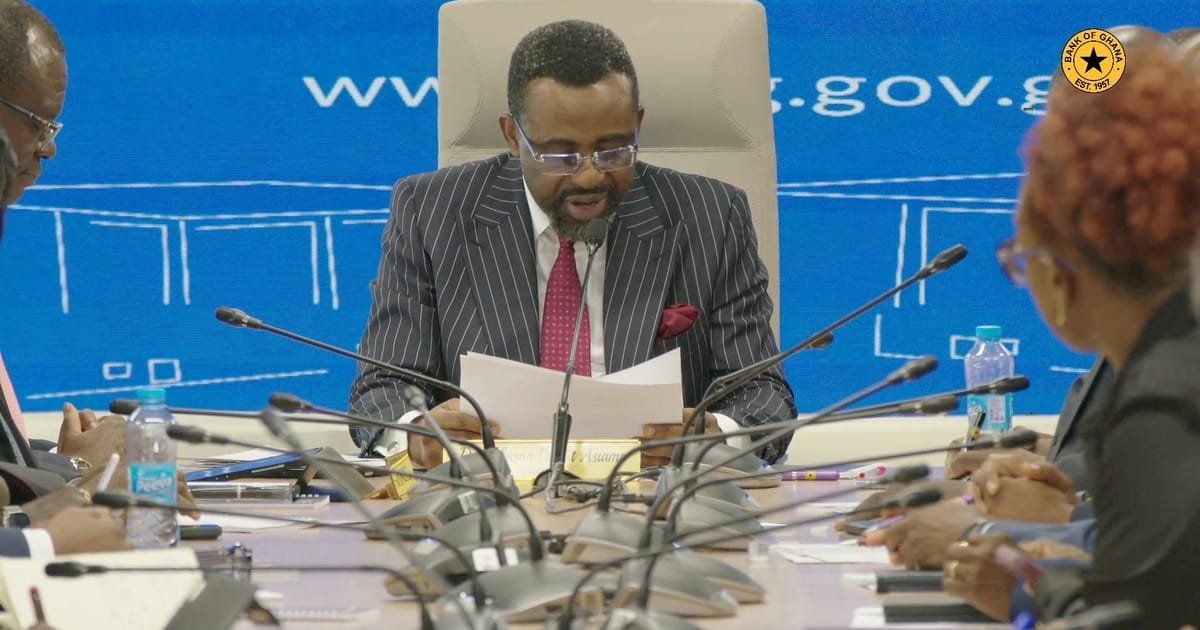
Governor Johnson Asiama says it is not a cut at all. “This is a realignment, not a reduction,” he told journalists after the meeting.
A week earlier, the 2027 budget cut the government’s primary surplus target to 0.5% of GDP, from 1.5%. That frees money to help pay for the US$10bn New Economy programme.
So Ghana is now easing on both levers at once. Money is cheaper at the central bank, and the Treasury has more room to spend.
That is happening while gold, which earns about two-thirds of the country’s export income, trades well below the price the IMF built into Ghana’s plans. Reserves are also lower than they were in January.
The Bank’s reasoning holds up on its own terms. The open question is timing: whether a country that has borrowed from the IMF 17 times should spend a commodity windfall or save it.
11%policy rate, the lowest since the MPC began in 2002
5.5%inflation in October
37.2%growth in private-sector credit, year to October
4.4months of import cover in gross reserves, against a six-month target

The reset
What the Bank of Ghana actually changed
This is a realignment, not a reduction
The committee made three changes. It replaced its 14-day open market bill with a seven-day bill, and it narrowed the band around the policy rate from four percentage points either side to one.
The third change moved the rate itself from 14% to 11%.
The band now runs from 10% to 12%. Before Wednesday it ran from 10% to 18%, so the bottom of the range has not moved, and only the top has come down.
The Bank’s case is that market rates had already left 14% behind. The 91-day Treasury bill yielded 4.6%, down from 10.6% a year earlier.
Banks’ average lending rate was 15.8%, down from 22.2%. In the committee’s words, the effective stance “is lower than the announced rate”.
“This is like a reset,” Asiama said. He added that the Bank had done something similar under a former governor.
Analysts did not see it coming. A Reuters poll had expected a hold, and Razia Khan of Standard Chartered told the agency the Governor went to “great lengths to explain that this is not an easing”.
Inflation was 5.5% in October, still under the Bank’s 6% to 10% target band. At 14%, the policy rate sat about 8.5 points above inflation.
At 11%, it is still about 5.5 points above. A positive real rate of that size is not the mark of a loose central bank.
The Governor also argued that credit has room to grow. Private-sector credit is “a mere 8.8%” of GDP, he said, against nearly four times that in Kenya and about six times in South Africa.
The Bank has faced pressure from the other side, too. Earlier this month, opposition MP Kojo Oppong Nkrumah asked whether it was squeezing jobs to tame inflation.
The fiscal record supports the Bank. The budget deficit for January to October was 1.0% of GDP, against a target of 3.0%.
Public debt stood at 47.5% of GDP at the end of October. Banks are in better shape, with the bad-loan ratio down to 13.1% from 19.5% a year earlier.
“When NPLs are low, then credit expansion becomes beneficial in all ways,” Asiama said.
Money on the move
Money and credit are already moving fast
The Bank’s own figures show how quickly money and credit have picked up.
Broad money grew 20.5% in the year to October, up from 8.2% a year earlier. Reserve money, the cash the central bank itself creates, grew 22.6%, against 0.1%.
Credit to the private sector rose 37.2%. After inflation, that is growth of 30%, against 5.4% a year earlier.
Inflation has turned with it. SBM Intelligence, a Lagos-based research firm that had urged the Bank to hold at 14%, noted that it fell for 15 months to a low of 3.2% in March and has now risen for three months running.
Food is holding the headline down. Food inflation eased to 2.8% in October, while non-food inflation jumped to 7.9% from 6.2%.
Core inflation, which leaves out energy and utilities, edged up to 5.2%. SBM put services inflation at 11.5%, up from 8.3%.
Wages are rising as well. The daily minimum wage goes up about 15% in January, to GH¢25.04 from GH¢21.77.
When money, credit and wages all rise together in a fast-growing economy, cheaper money adds to demand that is already strong.

The budget
The Treasury is loosening at the same time
The 2027 budget pays for the New Economy, a US$10bn plan for 2027 to 2030, partly by trimming the primary surplus goal by a full point of GDP. Fresh taxes worth 0.5% of GDP make up part of the rest.
Next year’s allocation is GH¢30bn. The cash deficit is projected at 3.6% of GDP.

Fitch Solutions expects capital spending of about 5% of GDP in 2027, the highest since around 2010. It also sees inflation climbing past 10% between July and December 2027, though it calls the fiscal risks “very much limited”.
Then there is the early buyback. The government plans to repay about GH¢29bn of DDEP bonds ahead of time in February, which puts cash into the banking system.

The Governor pointed to the sinking fund set aside for it. “We should be able to stem any impact of that early repayment,” he said.
The IMF backs the smaller surplus. In its August staff report, the Fund calculated that a primary surplus of 0.5% of GDP still brings debt down to Ghana’s legal anchor of 45% of GDP by 2034.
That sum assumes gold at US$4,500 an ounce. If the gold price falls 30%, the same calculation needs a surplus of 0.8%.

Gold
The metal that sits under everything
Ghana earned a record US$30.4bn from exports in the first ten months of 2026. Gold brought in US$20.9bn of it.
The committee put gold at about 67% of export earnings. “The country is still exposed to commodity price shocks,” Asiama said.
Gold traded at about US$3,782 an ounce on Wednesday. That is 16% below the IMF’s US$4,500 baseline, after a run earlier in the year that took it above US$5,000.
The Fund has modelled what a fall would do. A drop of about US$1,500 an ounce would cut reserves by roughly one month of imports a year, its staff found.
The Governor expects gold prices to strengthen over the medium term. He may be right, but both the budget and the reserves outlook rest on that forecast.

Who knows how much of that is being offshored
The trade surplus reached US$13.0bn between January and October, up from US$8.7bn a year earlier. That is close to, but not yet above, the full-year US$13.8bn of 2025.
Gross reserves still fell. They stood at US$12.1bn on 17 November, about 4.4 months of imports, down from US$13.8bn, or 5.7 months, at the end of 2025.

The Governor blamed the Middle East crisis and tighter global financing. Then he went further and admitted there was “some gap” between the trade figures and the build-up of reserves.
US$13.0bntrade surplus, January to October
US$6.5bncurrent-account surplus, first nine months
US$9.5bnnet outflow on the financial account, first nine months
He placed it in the financial account. Bank of Ghana data show a current-account surplus of about US$6.5bn in the first nine months, against net outflows of about US$9.5bn on the financial account.
The IMF has said where much of it goes. Its staff wrote in August that a large share of gold and oil export receipts “are not being repatriated”.
Asiama also pointed to remittances, which he put at about US$8bn. “Who knows how much of that is being offshored,” he said.
The Bank’s gold stock tells a similar story. It held 26.2 tonnes in October, rebuilt from 18.6 tonnes at the end of 2025, but still below the 38.0 tonnes it held in October 2025.
The 2027 budget targets reserves worth at least six months of imports, which is also the IMF’s estimate of what Ghana needs. Reserves now cover 4.4.

The calendar
Is there a Christmas pattern?
The MPC has changed its rate at a November or December meeting 11 times since 2002. Seven were cuts, in 2003, 2006, 2009, 2016, 2017, 2025 and now 2026, and four were rises, in 2014, 2015, 2021 and 2022.
The rises came as the cedi or prices came under pressure. The calendar alone does not explain the decisions.
The festive season still matters for the cedi, which is down 10.6% against the dollar this year after gaining about 41% in 2025, by the Bank’s measure.
Asked what he could promise Ghanaians for Christmas, the Governor’s answer was careful. “It’s conditional,” he said.
The cycle that does show up clearly in Ghana’s numbers is the election one. IMF data show overall deficits of 5.6% of GDP in 2008, 8.4% in 2012, 6.7% in 2016 and 6.0% in 2024.
The 2020 election year, which was also the pandemic year, hit 17.4%. In 2025 the deficit was 1.3%.
The IMF’s October outlook has it at 2.2% this year, widening to 2.8% in 2027 and in 2028, the year of the next election.
The last time the cycle broke badly, in 2022, inflation reached 54.1% and Ghana stopped paying most of its foreign debt.
Another way
The case for banking the windfall
Ghana’s stability is real, but it isn’t yet self-sustaining
The alternative view is that Ghana should treat gold money as a windfall to save, not income to spend, at least until reserves are rebuilt. Wednesday’s decision can stay where it is.
- Step 1Tie the fiscal room to gold
The IMF’s own sums give a guide, with a primary surplus of 0.5% of GDP at US$4,500 gold and 0.8% after a 30% fall. With gold now 16% below the baseline, a surplus target between the two would match the risk Ghana actually faces.
- Step 2Save the excess
Ghana already does this with oil: the 2011 Petroleum Revenue Management Act sends part of oil income into a Stabilisation Fund and a Heritage Fund. The same idea, applied to the state’s gold income above a reference price and run through the Minerals Income Investment Fund or the reserves, would bank part of the boom while it lasts.
- Step 3Pace the New Economy
SBM Intelligence advised the government to stagger new spending and favour projects that add supply. Releasing the GH¢30bn in tranches linked to the reserves level would protect the cedi without cancelling the programme.
- Step 4Bring the money home
Recovering more of the export and remittance dollars that now stay offshore would add to reserves without tighter policy, and the Governor himself raised the leak.
- Step 5Clear guidance before January
With credit up 37% and core inflation edging higher, the Bank could spell out what would make it hold, or reverse, at its next meeting.
The IMF’s Adrian Alter put the stakes simply this month. “Ghana’s stability is real, but it isn’t yet self-sustaining,” he said, as the IMF programme came to an end.

November inflation figures from the Ghana Statistical Service will show whether the three-month rise is continuing.
The reserves figure will show whether import cover stops falling at 4.4 months. The MPC meets again from 18 to 20 January, close to the first New Economy releases and the February buyback.
And there is gold. If it stays near US$3,800, Ghana’s plans rest on a price about US$700 above the market.