













Deep tech spin-offs need biz teams around scientists, says Origgin Capital CEO
 0
 0

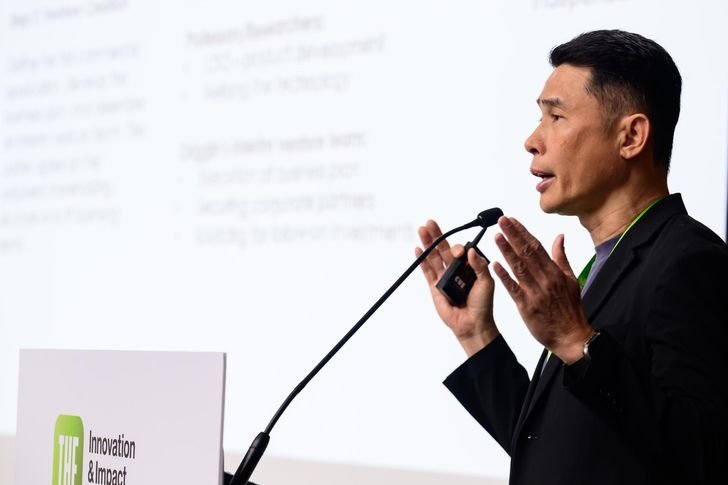
Origgin Capital CEO Clarence Tan speaks during his session “Lessons from collaboration with universities across Asia and success cases” during the Times Higher Education Innovation & Impact Summit 2026 at Korea University in Seoul, Thursday. Korea Times photo by Choi Won-suk
University patents lose value quickly if left unused, and turning them into businesses works best when commercial teams are built around researchers rather than when scientists are trained to be entrepreneurs, a Singapore venture investor said Thursday.
Clarence Tan, founder and managing partner of Origgin Capital, spoke at the Times Higher Education Innovation & Impact Summit 2026, a three-day conference hosted by Korea University in Seoul.
“Any patents or IPs (intellectual properties) are perishable items,” Tan said. He noted that the chances of commercializing a technology drop sharply two to three years after a patent is published, as competing technologies emerge.
Origgin uses what it calls venture co-creation. Once a lab technology is proven to work, the firm forms a startup, provides pre-seed funding — the earliest stage of investment — and installs interim executives from its own team. It typically spends 24 to 36 months bringing a company to its seed round before handing it to venture capital firms.
Tan said Origgin has spun off more than 50 deep tech startups — companies built on scientific or engineering breakthroughs — over about nine years from universities in Singapore, Thailand, Malaysia, Japan and China. It expanded to Taiwan, Hong Kong and Korea this year.
In one case, two professors at Nanyang Technological University (NTU) in Singapore asked for help in 2020 with fiber optic sensing patents that had gone unused for years. Origgin spun off a company, licensed the technology and supplied interim executives. In 2022, Japanese construction company Kajima invested $1 million to deploy the sensors at construction sites, and a full-time CEO later took over.
Other cases include MetaOptics, a lens maker that listed in Singapore last year, and EMASS, an NTU chip startup acquired by Australia’s Nanoveu.
Tan said market access matters as much as technology. Probicient, a National University of Singapore spin-off that brews probiotic beer, struggled in the city-state’s market of about 6 million people. After partnering with a Chinese brewer, it now produces about 100,000 liters a month and is expanding to 3,000 supermarkets in China.
He also cited a Korean university’s surgical dye for breast cancer surgery that faced regulatory hurdles at home. Origgin invested in the team and is running clinical trials in Singapore in parallel.
On equity, Tan recommended that researchers and commercial teams each hold 30 to 40 percent, investors no more than 20 percent and universities 5 to 10 percent, so that everyone has an incentive to grow the company.
“We need an entire village to raise a kid,” he said.