











Defense committee chair says OPCON agreement stands despite US midterm outcome
 0
 0

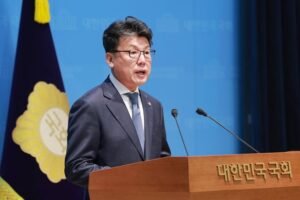
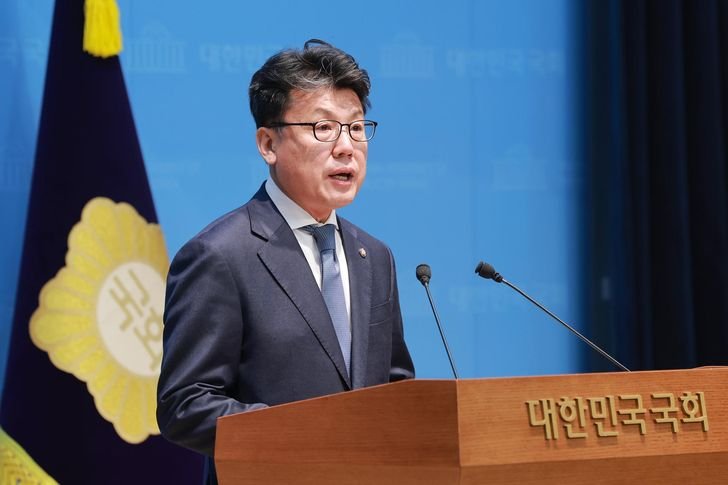
Rep. Jin Sung-joon of the Democratic Party of Korea, chair of the National Assembly’s National Defense Committee, briefs reporters at the National Assembly in Seoul, Sunday, on his five-day visit to Hawaii, where he led a bipartisan delegation to the U.S. Indo-Pacific Command and other military facilities. Yonhap
The United States acknowledged that certain policy-related variables could affect the transfer of wartime operational control (OPCON) to Seoul, but reaffirmed its commitment to the existing bilateral agreement that the handover will proceed based on agreed conditions, a Korean lawmaker said Sunday.
Rep. Jin Sung-joon of the ruling Democratic Party of Korea (DPK), who chairs the National Assembly’s National Defense Committee, briefed reporters at the National Assembly on the outcome of a parliamentary delegation’s trip to the United States from Nov. 1 to 5.
He said the delegation was granted entry approval only at the last minute, but was still able to proceed with its scheduled visit to U.S. Indo-Pacific Command and its subordinate component commands in Hawaii.
Asked whether the Democratic sweep in the U.S. midterm elections could affect the OPCON transfer process, Jin said he did not expect any significant changes.
“Korea and the U.S. have discussed and reached agreements over OPCON transfer for more than 20 years. A Democratic victory (in the U.S.) would not affect the existing bilateral agreements,” he said.
Regarding the postponement of the Security Consultative Meeting between Korea and the U.S., originally scheduled for November, until next year, Jin cited U.S. officials saying the delay was unrelated to any differences over the OPCON transfer.
“The U.S. said the decision was made after taking into account the two countries’ defense ministers’ and senior military officials’ schedules,” he added.
Jin said U.S. officials assessed the security situation on the Korean Peninsula as stable, despite a series of North Korean actions in the Demilitarized Zone (DMZ), including the demolition of inter-Korean connecting roads and the fortification of areas along the Military Demarcation Line (MDL).
“However, the officials stressed the need to maintain military readiness, citing North Korea’s growing nuclear and missile capabilities and the possibility of abrupt policy shifts,” said Jin.
Adm. Stephen T. Koehler, commander of the U.S. Pacific Fleet, reportedly said Korea’s pursuit of nuclear-powered submarines could strengthen the alliance, expressing willingness to cooperate pending policy decisions by both governments.
On Seoul’s request for cooperation in relocating Gwangju Air Base to build a mega semiconductor cluster, Gen. Kevin B. Schneider, commander of Pacific Air Forces, said the relocation is a sovereign decision for the Korean government, while the U.S. military’s role is to assess and advise on potential military risks.
Asked whether United States Forces of Korea Commander Gen. Xavier Brunson came up in the talks, Jin said he did, but declined to elaborate.
Brunson recently drew criticism from ruling party lawmakers after he said, at a seminar in Washington on Oct. 14, that Korea begins at the southern boundary fence line of the DMZ from the perspective of the United Nations Command.
The remark sparked controversy because it could be interpreted as placing Korea’s territorial boundary at the southern edge of the DMZ, 2 kilometers south of the MDL. The southern half of the DMZ, which includes villages where South Korean residents live, lies north of that line.