











SK Biopharmaceuticals builds massive AI dataset to speed up drug discovery
 0
 0

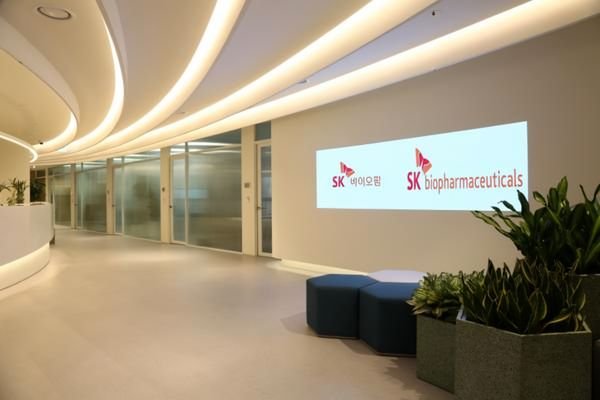
A view inside SK Biopharmaceuticals’ research and corporate headquarters in Pangyo, Seongnam, Gyeonggi Province / Courtesy of SK Biopharmaceuticals
SK Biopharmaceuticals, a Korean firm focused on developing original prescription drugs, has built a massive artificial intelligence (AI) dataset of more than 7 million chemical entries to streamline candidate screening for new therapies.
The project is part of the Ministry of Science and ICT’s program to develop AI foundation models for specific fields. A foundation model is a large AI model trained on vast amounts of data that can be adapted for many tasks. SK Biopharmaceuticals belongs to a medical and health care consortium led by medical AI firm Lunit, along with Trillion Labs, Kakao Healthcare and other companies, universities and hospitals.
The consortium built a base model specialized in medical science. It then developed versions focused on three areas: drug development, covering chemical compounds and proteins; omics, the large-scale study of genes and other biological molecules; and clinical research.
SK Biopharmaceuticals put together the drug discovery dataset based on what researchers actually need in the lab. The data covers 66 drug development tasks, including predicting a drug’s properties, toxicity, how it interacts with its biological target and the results of clinical trials.
Working with Trillion Labs, the company tested a drug discovery model against those 66 tasks. It also ran checks using a drugmaker’s own private data, not just public datasets.
The company also built an AI system to help with research paperwork. It developed a “digital twin,” a virtual model of a patient, that uses public Alzheimer’s disease trial data to predict how a patient’s cognitive function will change over time.
Going forward, the company plans to step up an AI-driven research strategy called TR-AX, short for Translational Research-AI Transformation. The plan will draw on what it learned from the project and on its recently acquired computing infrastructure built on Nvidia B200 graphics processing units.
“The competitiveness of AI in drug development ultimately depends on how meaningful the answers it can offer in actual research settings are,” CEO Lee Dong-hoon said.
This article was published with the assistance of generative AI and edited by The Korea Times.