








Korean tech helps uncover ancient Hellenistic city in Turkey
 0
 0
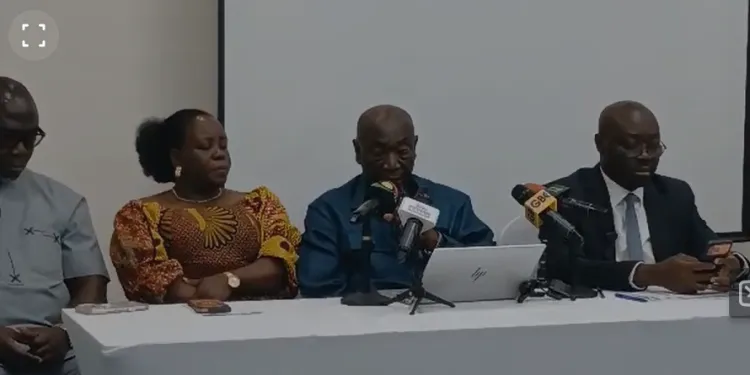
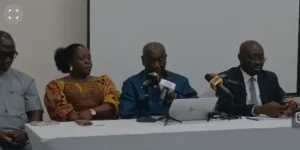
Bulent Gonultas, center, deputy director general of Turkey’s General Directorate of Cultural Heritage and Museums, speaks during a joint media interview at Koreana Hotel in Seoul, Tuesday. Next to him are Umut Gorgulu, left, head of Department of Excavations and Surveys at Turkey’s Ministry of Culture and Tourism, and Fikri Kulakoglu, professor of archaeology at Ankara University. Courtesy of Korea Heritage Service
A joint excavation between Korea and Turkey at an archeological site in central Turkey, has uncovered a sprawling Hellenistic urban complex and rare mosaic flooring dating back to around 2000 B.C., the Korea Heritage Service said on Wednesday, adding that the landmark discovery was possible due to Korea’s advanced technologies in architecture.
Kultepe served as the capital of the ancient Kingdom of Kanesh and a major trading hub for Assyrian merchants, yielding some of the earliest known written records from Anatolia. The newly identified structure and mosaic floor could provide new insights into the lesser-known Hellenistic history of the ancient settlement. Kultepe-Kanesh has been on Turkey’s UNESCO World Heritage Tentative List since 2014.
Turkish experts took a note of Korean researchers who used digital scanning and precise documentation technologies to analyze pottery fragments with unprecedented speed and accuracy.
“The Korean team is exceptionally thorough and organized,” said Fikri Kulakoglu, a professor at Ankara University who leads joint international research teams, during a joint interview in Seoul, Tuesday.
“Analyzing tens of thousands of pottery fragments per season is daunting, but Korea’s digital scanning and documentation drastically reduced processing time and minimized errors. He added that combining Korea’s top research talent and technology at Kultepe is generating “three to four times the synergy,” expressing hope that Turkey will adopt similar digital cataloging systems in the future.
An aerial view shows a newly unearthed structure at the Kultepe archaeological site in Kayseri, central Turkey. A joint excavation team from Korea’s National Research Institute of Cultural Heritage and Ankara University uncovered the site using 3D scanning and digital documentation technologies. Courtesy of Korea Heritage Service
Uncovering Anatolian history
Among many international teams actively working on the archeological site, Turkish officials said, the Korean team stood out with its technologies that helped prove the existence of a major Hellenistic center for the first time.
“Hellenistic structures previously found at Kultepe were very small in scale, making it impossible to determine the size of a Hellenistic city,” Kulakoglu explained. “Through this excavation, we can now prove that there were large-scale Hellenistic residences, temples and an actual sprawling city in central Anatolia — something never before confirmed through systematic excavation.”
The discovery of the mosaic floor further underscores the site’s architectural prestige. “Mosaics are extremely rare in central Anatolia; you can count them on one hand,” Kulakoglu added. “Mosaics were crafted by specialized artisans exclusively for sacred, ceremonial or high-status locations.”
Meaningful work for Korean archaeology
For Korea, the technological contributions and research success represent a major turning point.
Since beginning international excavations in 2000 under an agreement with Russia, Korea’s National Research Institute of Cultural Heritage (NRICH) concentrated for over two decades on sites in Northern and Central Asia, including Russia, Mongolia, Kazakhstan and Uzbekistan, as part of efforts to trace the origins of the Korean people and explore historical states like the Balhae kingdom (698-926).
Korean and Turkish archaeologists uncover Hellenistic mosaic floor at the Kultepe archaeological site in Kayseri, Turkey, in this 2026 file photo. Courtesy of Korea Heritage Service
However, the Kultepe joint excavation, launched in 2025, expanded that focus beyond Korean-related history.
“This joint investigation marks a new turning point, expanding Korean archaeology from its regional roots toward the study of ancient civilizations,” said Park Yoon-jung, director of NRICH’s archaeological heritage division. “By directly participating in the research of major global heritage sites beyond direct national ties, we are elevating the standing of Korean archaeology and building an international research network.”
Deepening bilateral ties
Bulent Gonultas, deputy director general of Turkey’s General Directorate of Cultural Heritage and Museums, said the collaboration with Korea will expand beyond arccheology.
“Geographically, our countries are far apart, but we consider each other brotherly nations. Through these continuous collaborations, we aim to further expand historical and cultural exchange between our two countries,” Gonultas said.
To share these discoveries with the public, both nations are preparing a special exhibition at the National Museum of Korea in Seoul next year, while establishing a framework for long-term academic and technical exchanges.