







Seoul offers no response to US Eighth Army commander remarks on broader USFK role
 0
 0

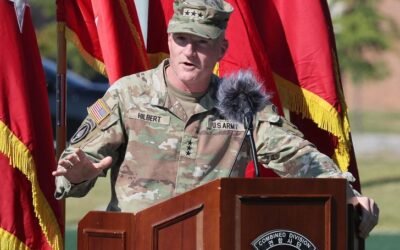
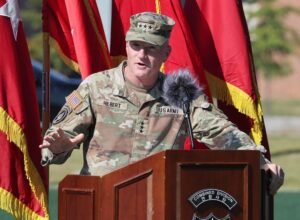
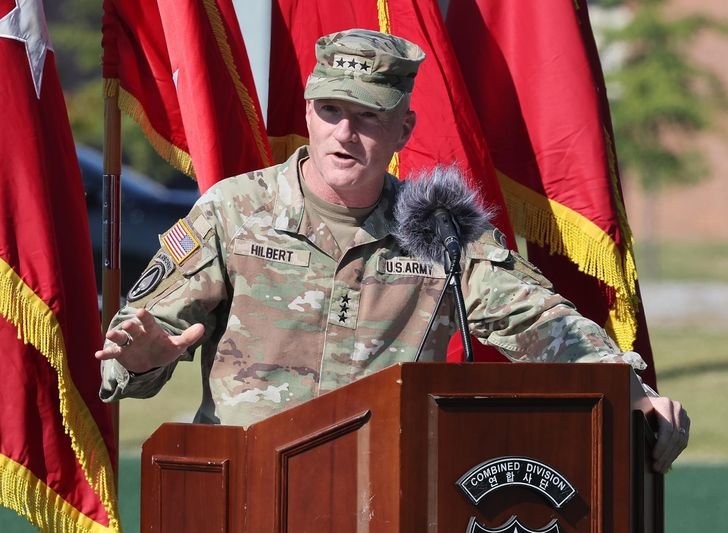
Lt. Gen. Joseph Hilbert, commander of the U.S. Eighth Army, speaks at a change-of-command ceremony for the 2nd Infantry Division and Republic of Korea-U.S. Combined Division at Camp Humphreys in Pyeongtaek, Gyeonggi Province, Oct. 7. Yonhap
The Seoul government held off on responding Thursday to remarks by the U.S. Eighth Army commander suggesting that American troops stationed here should be prepared for missions beyond countering North Korean threats.
Cheong Wa Dae, the Ministry of National Defense and the Joint Chiefs of Staff (JCS) did not comment when asked about Lt. Gen. Joseph Hilbert’s email interview with the South China Morning Post on the Eighth Army’s readiness for broader regional operations.
According to sources familiar with the South Korean military, the lack of comment reflected a reluctance to publicly interpret Hilbert’s remarks, rather than an articulated government position on a broader U.S. Forces Korea (USFK) role.
The sources noted whether deployments beyond the Korean Peninsula would require prior consultation between Seoul and Washington has yet to be clarified.
In an email interview published by the South China Morning Post on Wednesday, Hilbert said it would be “irresponsible to focus myopically” on threats within the Korean Peninsula or assume that being stationed in South Korea prevented his troops from undertaking other missions.
“We view readiness as largely threat-agnostic. If we have a trained, ready force capable of executing the Army’s assigned missions, we can apply that force against whatever threat is required,” he said.
Hilbert’s comments drew attention to a potentially broader regional role for USFK as Washington seeks greater flexibility to counter China while calling on Seoul to take more responsibility for deterring North Korea.
That shift could allow American troops stationed in South Korea to undertake missions elsewhere, including in a potential Taiwan Strait conflict, although Hilbert did not explicitly mention China or Taiwan.