













KOSPI’s biggest October rout problem: No one left to buy the dip
 0
0  0
0 
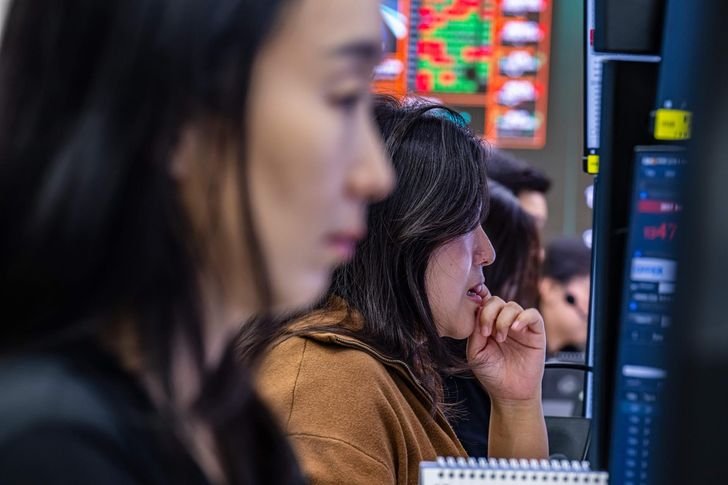
Dealers work at Hana Bank in Seoul, Thursday, as KOSPI plunged 7.57 percent. Korea Times photo by Shim Hyun-chul
Korean stocks may be facing a more troubling sell-off than July’s rout, as a shrinking pool of buyers struggles to absorb foreign selling pressure, analysts said Sunday.
KOSPI fell for seven straight sessions through Thursday, losing 20.7 percent and falling to 5,554.22. The benchmark rebounded 2.05 percent Friday, but Korean stocks were hit particularly hard in Asia’s broader sell-off.
The slump comes less than three months after the benchmark plunged from 9,385.59 on June 19 to 5,262.77 on July 29, before recovering above 7,000.
Despite resilient earnings expectations, the market backdrop differs from that of July, when a euphoric rally pushed the KOSPI above 9,000. The latest sell-off, by contrast, has battered a market already struggling to regain momentum.
David Chung, founder and CEO of Redpoint Partners, said KOSPI has gained about 60 percent this year despite foreign investors selling a net 200 trillion won ($149.4 billion) in Korean equities.
“Foreign selling has been a constant in the Korean stock market this year, but the key variable has been who is willing and able to absorb it,” the Seoul-based Asia equity manager said.
That buying support now appears weaker, despite the recent fall in share prices.
The National Pension Service expanded its permitted allocation range for domestic equities during the first-half rally and did not sufficiently reduce its stock exposure near the peak, leaving it with limited room to buy at lower prices during the recent sell-off.
Last Tuesday, when KOSPI extended its losing streak to five sessions, foreign investors offloaded a net 4.54 trillion won in shares, far exceeding the 51.4 billion won in net purchases by pension funds and similar institutions, according to the Korea Exchange. A day earlier, those funds bought in a net 145 billion won against foreign net selling of 2.02 trillion won. Their modest purchases have provided little cushion against the latest market downturn.
Corporate buyback programs, another source of buying support, are also winding down. Samsung Electronics completed its 15 trillion won program on Oct. 6, while SK hynix had spent 37 trillion won of its planned 40 trillion won as of Wednesday. The purchases have helped absorb selling by other investors.
Retail investors, meanwhile, are still nursing losses from July’s rout, leaving them with less capacity to buy additional shares.
Historical rebound patterns may offer a less reliable guide this time, Chung said.
“During the market crises of 2008, 2011 and 2020, KOSPI rebounded within three months 84 percent of the time when the VKOSPI (fear index) exceeded 45,” he said.
“But this year, a reading of 45 has become the norm, while Thursday’s level of 56 remains well below the peak of 97 in late June. That makes historical recovery patterns less reliable and suggests it may be too early to call a bottom.”
Dip-buying has shifted toward riskier bets. Unlike in July, when investors bought both conventional and leveraged exchange-traded funds (ETF), inflows are now concentrated in leveraged products including the Direxion Daily South Korea Bull 3X ETF and KODEX Leverage ETF. These funds’ daily rebalancing can add to selling pressure when markets fall, potentially amplifying declines.
There is also less room for short covering to fuel a rebound. Short interest in the iShares MSCI South Korea ETF, a major U.S.-listed fund tracking Korean stocks, reached 27.7 percent in July before investors closed out 43 percent of their short positions within two weeks, helping fuel the August rally. The ratio has since fallen to a cycle low of 8.7 percent, suggesting less potential buying support from short covering this time.
Despite these constraints on buying support, global investment banks say the recent plunge has made Korean stocks more attractive on valuation grounds, while the growth outlook for memory chips remains intact.
Goldman Sachs puts the market’s forward price-to-earnings ratio at 5.1 times, while Morgan Stanley estimates its forward price-to-book ratio at 1.05 times, near the historical average. Still, uncertainty over external risks and liquidity conditions clouds the timing of a sustained recovery, according to Morgan Stanley.