









Hyundai Motor steps up physical AI push amid Chinese competition, stock slump
 0
0  0
0 
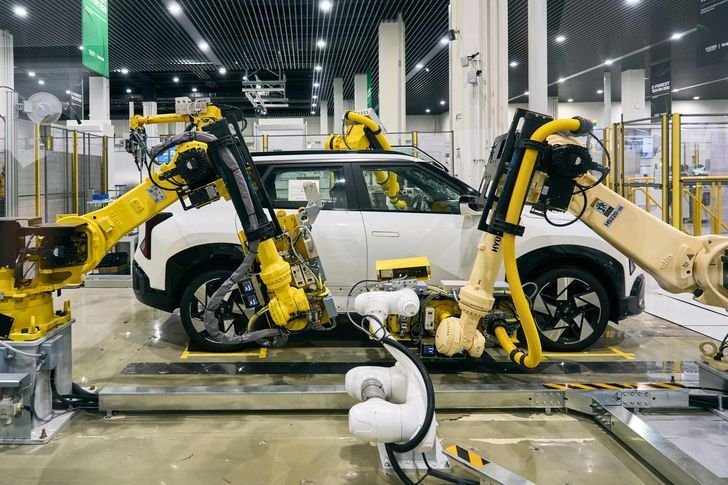
Industrial robotic arms automatically attach door trim to a vehicle at Hyundai Motor Group’s Uiwang Research and Development Center in Uiwang, south of Seoul, Oct. 14. Yonhap
UIWANG, South Korea — Seeking to remain competitive against fast-growing Chinese automakers and find new sources of growth amid a sharp retreat in its share price, Hyundai Motor Group is stepping up its push into robotics and physical artificial intelligence (AI).
The move comes as the world’s third-largest automotive group faces growing pressure to improve profitability in its conventional carmaking business amid intensifying competition in the global electric vehicle (EV) market, particularly from lower-priced Chinese models.
Investors are also questioning when the group’s heavy investments in robotics will start to pay off.
Hyundai Motor Co.’s shares more than doubled after its U.S. subsidiary Boston Dynamics unveiled its Atlas humanoid robot at the Consumer Electronics Show (CES) in January, reaching a record closing high of 755,000 won ($565.2) in June.
But the stock has since fallen sharply to near pre-CES levels, closing at 312,000 won Friday, as enthusiasm over robotics has faded amid weak earnings and growing concerns about how soon the technology can turn profitable.
Speculation about a delayed initial public offering of Boston Dynamics has added to the uncertainty. The U.S. robotics company reportedly incurred cumulative losses of around 1.7 trillion won over the past five years.
The sharp drop in stock price shows the challenge facing Hyundai: turning excitement over its robotics business into actual profits while keeping its core automotive operations competitive.
“Shares of Hyundai Motor have fallen sharply amid weakness in its core automotive business,” Lee Sang-soo, an analyst at iM Securities, said. “Growing concerns over potential delays in Boston Dynamics’ business plans have also fueled calls for lower valuation multiples.”
Against this backdrop, Hyundai is developing AI-powered factory systems, logistics robots and automated vehicle inspection technologies to boost productivity and reduce manufacturing costs at its Uiwang Research and Development Center, south of Seoul.
The group’s E-Forest Center is leading efforts to integrate AI, robotics and other smart manufacturing technologies into its factories, making production lines more flexible and efficient.
The company is working with U.S. chip giant Nvidia Corp. on Polaris, an AI-powered manufacturing platform that helps factory workers access information, analyze production data and handle daily tasks more efficiently.
It is also developing AI-based inspection systems that can automatically spot defects on vehicle exteriors, reducing reliance on outside suppliers and cutting costs. The technology is set to be introduced at Kia’s EVO WEST plant in Hwaseong, southwest of Seoul.
Another project focuses on using computer simulations to automatically generate movement paths for industrial robots, reducing the need for manual programming. Development is expected to be completed by June 2027.
These efforts are part of a longer-term road map to build factories where AI and robots can handle increasingly complex tasks with less human intervention.
The group aims to develop more advanced autonomous manufacturing systems at its Hyundai Motor Group Innovation Center Singapore (HMGICS) by 2030 before introducing humanoid robots and more extensive automation at future factories from 2032.
The strategy underscores how Hyundai hopes to use physical AI not only to create new businesses but also to make its existing car factories more efficient and competitive.
“Our goal is to create a manufacturing environment where people can focus on safer, higher-value tasks, while data and AI help make factory operations more flexible and sustainable,” said Choi Young-tae, head of Hyundai Motor Group’s E-Forest Center, during a media event Friday.