








Main opposition slams gov’t over S. Korea-US gap on OPCON transfer
 0
0  0
0 
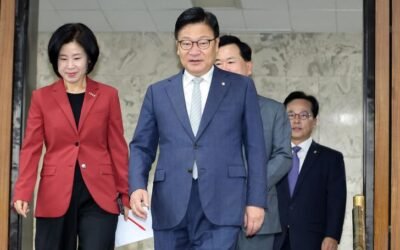
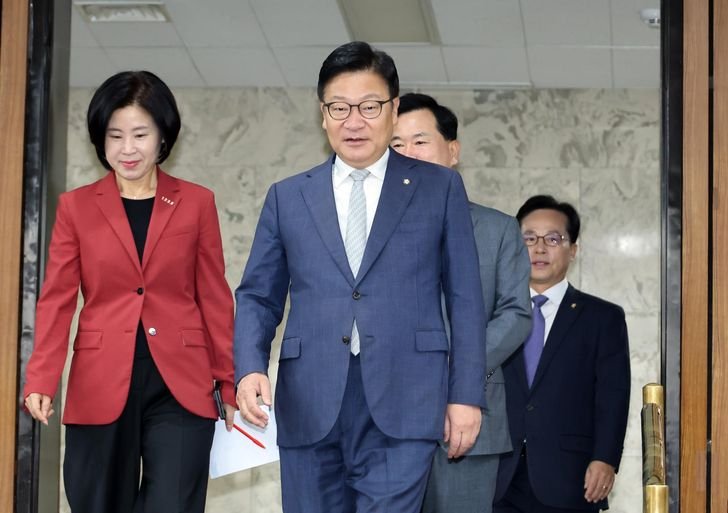
Jeong Jeom-sig, center, floor leader of the main opposition People Power Party, attends a party meeting to discuss the ongoing parliamentary audit at the National Assembly in Seoul, Friday. Yonhap
The main opposition People Power Party (PPP) on Friday criticized the government over what it called apparent differences between South Korea and the United States on the transfer of wartime operational control (OPCON), calling it a “serious diplomatic blunder.”
The criticism came after U.S. Forces Korea (USFK) Commander Gen. Xavier Brunson said earlier this week that “conditions have changed” and that calls for new standards in the OPCON transfer, citing North Korea’s recent missile launches.
During a parliamentary audit of military courts on Thursday, Defense Minister Kang Shin-chul said that the requirements for the OPCON transfer remained unchanged and that Seoul has conveyed its concerns to Washington.
“Instead of reviewing the warning, the Lee Jae Myung administration and the Democratic Party of Korea (DPK) made a series of intimidating remarks directed at the USFK commander,” Rep. Kim Tae-kyu, the PPP’s chief floor spokesperson, said in a commentary.
Rep. Kim also criticized the defense ministry’s spokesperson for saying at an official press briefing that the transfer would never take place if “the goalpost kept moving,” while maintaining that it was her own view.
“It is a serious diplomatic and security blunder for a spokesperson of a ministry responsible for national security to weigh in emotionally on a sensitive issue between South Korea and the U.S., and to hide behind her personal opinion to evade responsibility,” he said.
Rep. Kim also urged President Lee to immediately halt the “reckless push” to complete the transfer within his term to tout it as an achievement, and called on the ruling DPK and the defense ministry to issue an apology for remarks that he said undermined the South Korea-U.S. alliance.
Rep. Jung Hee-yong, the PPP’s secretary-general, argued the security situation is “too grave” to rush the transfer as Pyongyang continues to advance its nuclear and missile capabilities.
“Failing to lodge a single protest against North Korea’s land mine provocations while hastily pushing for the OPCON transfer despite differences between South Korea and the U.S. only heightens public anxiety over security,” Jung said during a party meeting.
Brunson’s comments came amid a perceived gap between Seoul and Washington over the timing of the OPCON transfer.
Seoul seeks to retake wartime OPCON from Washington before the Lee administration’s five-year term ends in 2030, or even as early as next year. Washington has expressed reservations about rushing the transition out of political considerations.