













Stronger won fuels fears of earnings misses among Korean exporters
 0
0  0
0 
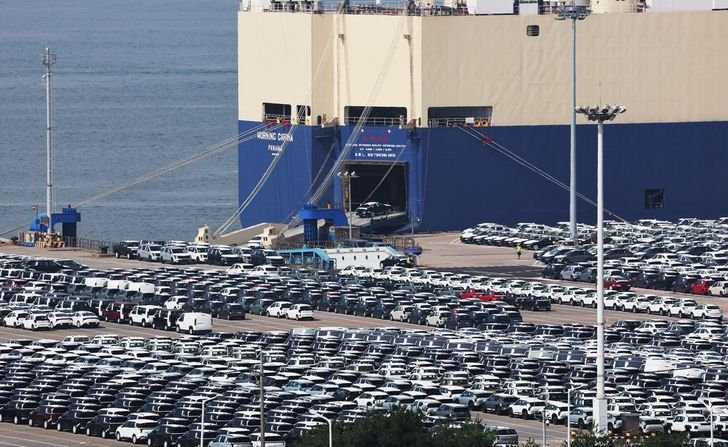
Vehicles for export stand ready at Pyeongtaek Port in Gyeonggi Province, Sept. 16, 2025. Yonhap
Korea’s leading exporters face a growing risk of missing third-quarter earnings expectations as a sharp appreciation of the won erodes the local-currency value of sales generated in dollars, market analysts said Friday.
The currency shift has prompted brokerages to lower their profit estimates for major exporters.
A weaker won benefited exporters in the second quarter, when the won-dollar exchange rate averaged 1,502 won per dollar. That advantage has since faded, with the rate falling 12.7 percent from 1,549.4 at the end of June to 1,352.9 at the end of September, squeezing profitability.
When the won strengthens against the dollar, dollar-denominated revenue and profits are worth less in won terms. The appreciation can also make Korean products less competitive on price in global markets.
Companies are increasingly concerned that their results could fall short of even the lowered consensus estimates, with some fearing substantial earnings misses.
Automakers, which rely heavily on overseas sales, are particularly exposed. Data from financial information provider FnGuide show that analysts cut their average forecast for Hyundai Motor’s third-quarter operating profit by about 16 percent over the past month, from 3.05 trillion won ($2.27 billion) to 2.56 trillion won.
Even that lower estimate may prove optimistic. Analysts calculate that each 10 won movement in the won-dollar exchange rate can change Hyundai’s annual operating profit by about 200 billion won to 300 billion won.
Labor-related production setbacks and questions over Hyundai’s electric vehicle (EV) competitiveness have compounded the currency pressure. FnGuide data show that 15 brokerages reduced their price targets for the automaker between September and Oct. 12. Analysts say Chinese manufacturers’ expansion into Korea and Europe with lower-priced EVs is costing Hyundai market share, as its lineup offers too few affordable alternatives.
“A lack of concrete strategies for robotics, autonomous driving and software-defined vehicles, combined with strike-related volume declines and the stronger won, has kept Hyundai’s shares under pressure,” said Chang Moon-su, an analyst at Hyundai Motor Securities.
The currency headwinds extend across manufacturing, affecting chipmakers, shipbuilders and cosmetics companies.
Despite expectations that a semiconductor supercycle will lift SK hynix’s earnings to a record, its consensus third-quarter operating profit forecast stood at 76.97 trillion won on Wednesday, down about 4.55 trillion won from 81.51 trillion won three months earlier.
Shipbuilders are also vulnerable because they receive payments for vessels in dollars. Korea Investment & Securities estimates that the 84 won quarter-on-quarter decline in the average won-dollar exchange rate reduced third-quarter operating profit at Hanwha Ocean and HD Hyundai Heavy Industries by 89.8 billion won and 38.7 billion won, respectively.