


President stresses national interests in diplomacy, acknowledges disagreements with US
 0
0  0
0 
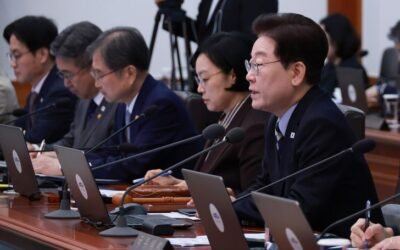
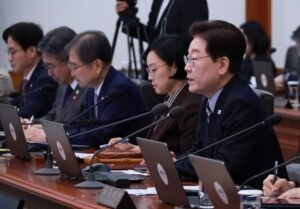
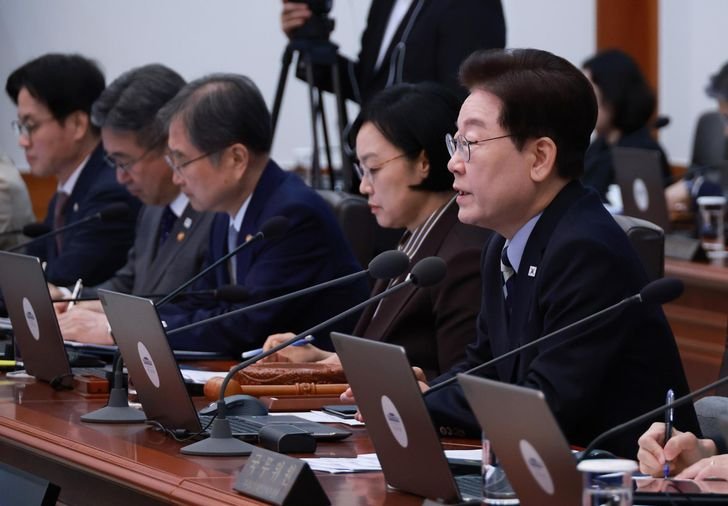
President Lee Jae Myung speaks during a weekly Cabinet meeting at Cheong Wa Dae in Seoul, Tuesday. Yonhap
President Lee Jae Myung said Tuesday that disagreements can exist between countries, while stressing that Korea must put its national interests first and “avoid submissive attitudes or excessive servility” in its diplomacy.
Speaking to ministers and presidential aides during a live broadcast of the weekly Cabinet meeting at Cheong Wa Dae, Lee made the remarks as disputes over intelligence sharing, U.S. visa delays for high-profile Korean figures and limited access to senior White House officials heightened concerns over the Korea-U.S. alliance.
Conservative politicians have accused Lee’s liberal government of undermining decades of trust, while progressive figures have argued that some objections from the U.S. are misplaced.
“Disagreements can exist between countries … how can their interests always align when each pursues its own national interests?” Lee said, adding that countries must continually discuss their differences, make their positions clear and work toward agreement.
He called for efforts “to minimize differences and keep them within manageable bounds,” but emphasized that “the existence of differences itself cannot be treated as a problem.”
Lee described the Korea-U.S. alliance as “very important and a pillar of our diplomacy that we must continue to strengthen.”
“At the same time, managing relations with the major powers surrounding us remains important,” he noted.
Lee nevertheless made clear that “Korea is a sovereign, independent country, and what matters most is Korea’s national interests.”
“We must always conduct diplomacy that confidently protects Korea’s national interests,” he continued, urging the country to “avoid submissive attitudes or excessive servility” in relations with other countries.
The president’s emphasis on managing disagreements challenges conservative arguments that recent friction collectively points to declining U.S. confidence in Seoul’s foreign policy and security leadership.
The National Intelligence Service (NIS) was reportedly excluded from a June trilateral meeting involving Japan on Pyongyang’s cyber threats at Washington’s request.
Since taking office in August, U.S. Ambassador to Korea Michelle Steel has met other ministers handling security affairs but has yet to meet Unification Minister Chung Dong-young, whose remarks conservatives have repeatedly criticized as pro-Pyongyang.
Chung has countered that shared alliance values do not mean interests always coincide.
U.S. visa delays for NIS personnel and Rep. Jung Chung-rae, former chairman of the ruling Democratic Party of Korea, have fueled further criticism, although the NIS denied that its staff had been refused visas or that Washington had rejected a planned visit by Director Lee Jong-seok.
The main opposition People Power Party (PPP) has portrayed these developments as warning signs across diplomatic, intelligence and security channels, with some PPP lawmakers demanding the dismissal of the unification minister and the NIS director.
The friction comes as Donald Trump’s second administration has clashed with other longstanding partners over tariffs and security commitments.
Nevertheless, Korean Ambassador to the U.S. Kang Kyung-wha’s testimony at Monday’s parliamentary audit of the embassy in Washington highlighted practical difficulties in resolving the disputes.
“I admit there are limits to communication with the White House,” she said, describing high-level consultations as frustratingly short of what she sought.
Kang acknowledged that Seoul had not sufficiently addressed U.S. intelligence concerns, although agency-level talks had made progress.
She did not recall Washington mentioning specific officials like Chung or Lee Jong-seok.