












Study links academic backgrounds to problem-solving pathways
 0
0  0
0 
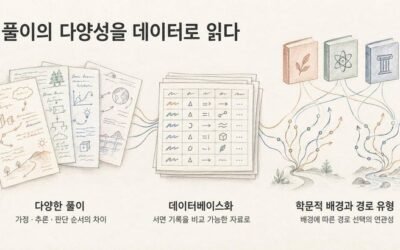
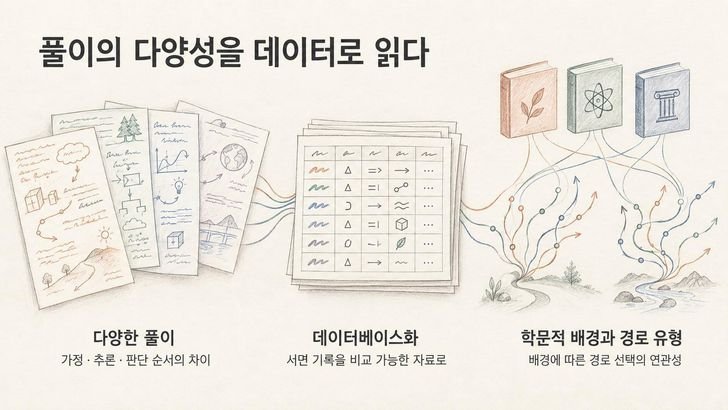
This artificial intelligence-generated illustration depicts the classification of students’ written solutions into problem-solving pathways associated with their academic backgrounds. Courtesy of Sejong University
A Sejong University professor has collaborated with a researcher at Finland’s Aalto University to examine how university students’ academic backgrounds relate to their problem-solving approaches.
The researchers are Jang Hye-won, a professor at Sejong University’s Office of Educational Innovation, and Petter Holme, a professor of computer science at Aalto University.
They analyzed 84 written solutions from a first-year physics course at Harvard University, systematically organizing information about students’ assumptions and reasoning sequences to examine how their approaches differed by academic background.
The study was published online last month in the International Journal of Science and Mathematics Education under the title “Through Different Lenses: Connecting Educational Backgrounds to Fermi Problem-Solving Pathways.”
The study used a Fermi problem, which requires people to make reasonable assumptions and arrive at approximate answers despite limited information.
Such problems require learners to identify relevant variables, make reasonable estimates and assess whether their results are realistic.
By using a task that required little specialized knowledge, the researchers focused on how students approached and worked through the problem.
The analysis identified two main problem-solving pathways. In the first, known as the “top-down pathway,” students started with a target amount and worked backward to determine what would be required to reach it and whether the target was feasible.
In the second, a “bottom-up pathway based on target-revenue comparison,” students estimated individual components, combined them to calculate projected revenue and compared the total with a tuition-related cost target.
Engineering students were more likely than students in other fields to follow the bottom-up pathway.
A logistic regression analysis controlling for prior coursework in physics and calculus found that engineering students had 3.43 times the odds of following this pathway. Even students who followed the same pathway differed in their assumptions and specific problem-solving strategies.
The findings suggest that understanding how students solve problems requires examining the structure of their reasoning as well as the accuracy of their final answers.
In educational settings, this type of analysis could help educators evaluate the validity of students’ assumptions and the consistency of their reasoning, while identifying areas in which students may benefit from additional feedback.
The study also offers a systematic method for comparing evidence of students’ reasoning in their written solutions.
The researchers used a four-stage writing process — prior training, initial attempts, detailed documentation and reflection — and applied “dimension-based coding” to systematically classify students’ written responses.
The university said the team plans to build on these findings by developing artificial intelligence-based assessment methods that analyze the assumptions and problem-solving pathways reflected in students’ written responses.