
















Samsung Display, Nvidia team up to showcase premium OLED gaming
 0
0  0
0 
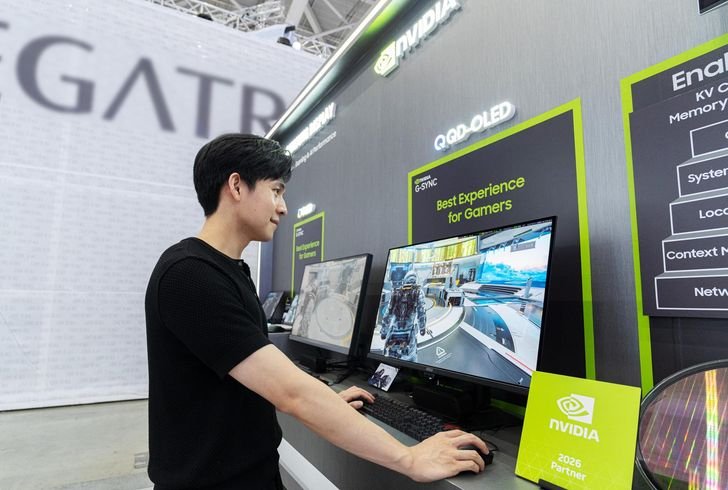
A person experiences a premium gaming setup powered by Nvidia’s latest GeForce RTX 50 Series graphics processing units and Samsung OLED and QD-OLED displays at Computex 2026 in Taipei, Taiwan. Courtesy of Samsung Display
Samsung Display has teamed up with Nvidia to demonstrate a premium gaming experience powered by advanced graphics processing and OLED display technologies at Computex 2026, Asia’s largest IT exhibition.
The company said Tuesday it is operating a gaming experience zone at the Taipei Nangang Exhibition Center, where visitors can experience the visual capabilities of Nvidia’s latest GeForce RTX 50 Series graphics processing units (GPUs) paired with Samsung OLED and QD-OLED panels.
The showcase features ASUS’ ROG Zephyrus G16 gaming laptop and MSI’s MPG 322UR QD-OLED X24 monitor. Both products incorporate Samsung Display panels and are powered by GeForce RTX 5080 and RTX 5080 Laptop GPUs.
Visitors can compare gameplay on LCD and OLED displays side by side to evaluate how each technology reproduces graphics generated by Nvidia’s latest processors.
The featured game is Capcom’s upcoming sci-fi action-adventure title Pragmata, which is set on a lunar base and includes visually demanding scenes featuring metallic reflections, shadows and the darkness of outer space.
Samsung Display said Nvidia’s GeForce RTX 50 Series GPUs enhance the game’s realism through path tracing technology, which simulates the behavior of light, and DLSS 4.5, the company’s artificial intelligence-based image enhancement technology.
According to Samsung Display, OLED and QD-OLED displays are particularly suited for showcasing such graphics because they are self-emissive and can achieve a contrast ratio of 1,000,000:1 while delivering deep black levels. The company also highlighted the fast response times of OLED technology, which help reduce motion blur during fast-moving scenes.
“In Pragmata, players can see clear images with reduced motion blur even as the main characters move quickly through the lunar base or during fast-paced scene transitions,” a Samsung Display official said.
The official added that the displays can accurately reproduce subtle color variations and details, helping to create a more immersive gaming experience.
“As real-time light reflection, shadow rendering and HDR effects become more sophisticated in the latest GPU-powered environments, differences in display performance become even more apparent,” said Kim Young-seok, vice president and head of IT sales at Samsung Display.
“Samsung OLED and QD-OLED are displays that best translate advanced GPU performance into the viewing experience, and we will continue expanding collaboration with leading technology companies to further demonstrate their value in the premium IT market.”