











President defends state backing for chip industry against US tariff scheme
 0
 0

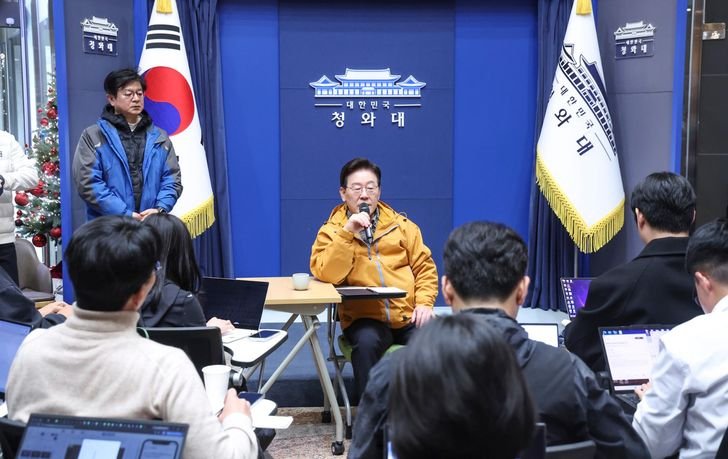
President Lee Jae Myung speaks during a press briefing at Cheong Wa Dae in Seoul, Sunday, following a hike with members of the presidential press corps. Yonhap
President Lee Jae Myung defended a greater government role in industrial development on Sunday, after the United States cited Korea’s plans to build state-backed semiconductor clusters in its latest tariff proposal.
Lee argued that industrial competition has moved beyond rivalries among companies to a contest among nations, with access to capital and infrastructure increasingly determining how quickly businesses can expand.
“We’re past the point where we can simply leave things to companies, and the government now has a bigger role to play than individual firms do,” he said during a press briefing at Cheong Wa Dae, following a hike with members of the presidential press corps.
“We’ve reached an era in which how well governments do their jobs can shape the course of civilization itself,” the president added.
Lee warned that countries could quickly lose ground if their governments failed to act.
“We can’t survive in the global economy unless governments step up,” he said. “How well they do so will influence how their companies compete in the years ahead.”
He cited the semiconductor cluster to be built by Samsung Electronics and SK hynix in Jeonnam-Gwangju Special Metropolitan City, saying the government is playing a role in creating environment and infrastructure in rural areas so that companies can do business there.
The president’s remarks followed the U.S. Trade Representative’s (USTR) Section 301 report, Wednesday, which concluded that Korean tax breaks and infrastructure support aimed at expanding manufacturing capacity burden U.S. commerce.
Based on the report, the USTR proposed additional tariffs on Korean goods, bringing the total tariff rate to 15 percent in line with last year’s bilateral trade agreement.
But Washington warned that the tariff rate could rise to 25 percent if talks with Seoul fail to ease U.S. concerns that Korea’s government-backed expansion could lead to an oversupply of chips.
The USTR singled out semiconductors as a prime example of what it called structural overcapacity, citing a planned chipmaking hub in southwestern Korea, for which Samsung Electronics and SK hynix each pledged 400 trillion won ($298.8 billion) to build a total of four chip fabrication plants.
The report pointed to dominance of the two companies in the global memory chip market and argued that tax breaks and state support for power and water infrastructure could fuel excess supply.
The cluster is one of three megaprojects the Lee administration unveiled on June 29, alongside initiatives in artificial intelligence (AI)-powered robotics and AI data centers.
The government also plans to use land at Gwangju Air Base, which is also used by the U.S. Air Force, for the cluster once military operations relocate.
The project is intended to create a second major chipmaking hub outside the Seoul metropolitan area.
Meanwhile, the Ministry of Trade, Industry and Resources disputed Washington’s finding of structural overcapacity and said Seoul is unlikely to change its industrial policy. It also said it would continue talks with Washington to avert a tariff increase.