







Sogang University expands AI collaboration with University of Toronto
 0
 0

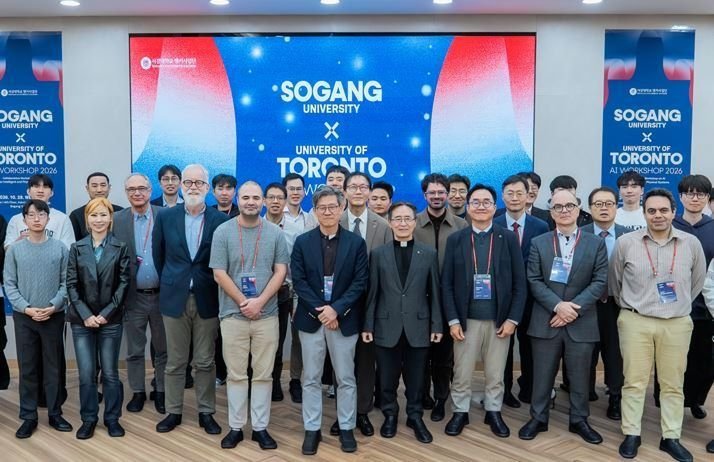
Participants pose during the Sogang-University of Toronto Collaborative Workshop on AI for Intelligent and Physical Systems at Sogang University’s Seoul campus, Oct. 28. Courtesy of Sogang University
Sogang University is expanding collaboration with the University of Toronto in education, research and talent development, with a focus on artificial intelligence (AI) and robotics.
The two universities held a joint workshop on Oct. 28 at Sogang’s Seoul campus to share research findings and explore opportunities for joint research and talent development.
The Sogang-University of Toronto Collaborative Workshop on AI for Intelligent and Physical Systems was organized by Sogang’s College of Computing and Anchor Project Group and supported by the Seoul Metropolitan Government.
The workshop followed a memorandum of understanding signed by the two universities in January and aimed to translate the agreement into concrete educational and research initiatives.
The partnership is part of Sogang’s efforts to realize its vision of becoming an “AI-Driven University.”
Sogang President Sim Jong-hyeok expressed hope that the partnership would lead to expanded joint education and research.
“Through these efforts, Sogang University will play a key role in helping Seoul emerge as a global hub for the AI industry,” he said. “We will further advance our ‘AI Driven University’ vision and strengthen the foundation for fostering globally competitive AI convergence talent who can connect Seoul with the world.”
Faculty members and researchers from both universities participated in two parallel sessions: “AI Learning, Optimization, and Decision-Making” and “Physical AI, Intelligent Engineering, and Manufacturing.”
The University of Toronto delegation comprised eight faculty members, including Chi-Guhn Lee and Markus Bussmann of the Department of Mechanical and Industrial Engineering.
Participants presented research integrating AI with engineering expertise, covering causal learning for manufacturing AI, inverse optimization, combinatorial optimization and physical AI.
They also exchanged views on interdisciplinary research and discussed ways to advance AI transformation by combining AI technologies with domain knowledge in computer science, mechanical engineering and other fields.
The universities also explored industry-academia collaboration with LG CNS, an IT services affiliate of LG Group, at the company’s Robotics & Physical AI Forum.
Discussions focused on potential cooperation in physical AI, including joint research, project-based education and internships that connect university research capabilities with industry needs.
Sogang and LG CNS signed an agreement in September to promote cooperation in AI and technology management, including industry-linked academic programs and joint research.
Sogang said the meeting helped connect the University of Toronto’s research capabilities with its existing partnership with LG CNS, broadening the scope of international industry-academia collaboration.
The two universities held a separate consultative meeting on educational and research cooperation on Oct. 30 at the Seoul Garden Hotel.
They discussed co-teaching, AI-related course development, international joint projects and exchanges of research personnel, as well as plans for industry-academia programs involving LG CNS.