













More Koreans want to marry, but financial hurdles remain
 0
 0

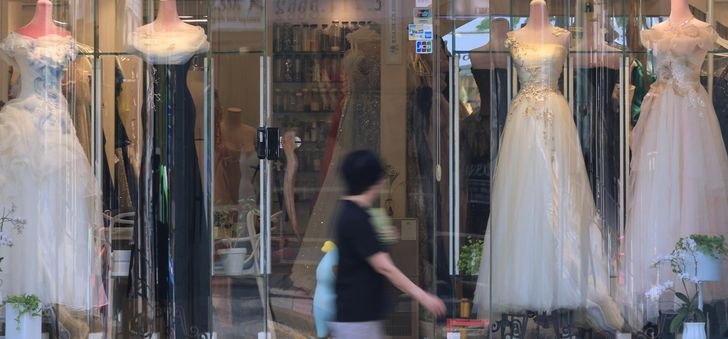
A pedestrian walks past a bridal shop in Seoul, Nov. 12. Yonhap
The share of Koreans who believe people should get married has reached its highest level since 2014, while the proportion who think married couples should have children has surpassed 70 percent for the first time.
Although positive attitudes toward marriage and childbirth are recovering, financial circumstances remain the biggest obstacle discouraging people from tying the knot, a survey has found.
The findings point to the need for policies that stabilize the living conditions of younger generations, particularly in housing and employment, to address the country’s persistently low birthrate.
According to the 2026 Social Survey released by the National Data Agency on Wednesday, 55 percent of people aged 13 and older said they believe people should get married. That was up 2.5 percentage points from two years earlier and the highest figure since 2014, when the proportion stood at 56.8 percent.
Positive attitudes toward marriage had fallen to 48.1 percent in 2018 before recovering to 51.2 percent in 2020, 50 percent in 2022 and 52.5 percent in 2024. The latest figure marks a further increase to 55 percent.
The share of respondents who believe married couples should have children also rose 1.8 percentage points from two years earlier to 70.2 percent, the highest level since the question was first included in the survey in 2018.
Despite the simultaneous improvement in attitudes toward marriage and childbirth, supportive economic conditions are needed to translate these positive perceptions into actual marriages and births.
In the latest survey, the most frequently cited reason for not getting married was insufficient funds for marriage, accounting for 29 percent of responses. Job insecurity ranked second at 15.5 percent, followed by the burden of childbirth and child-rearing at 12.5 percent.
Notably, the proportion citing unstable employment rose 2.6 percentage points from 12.9 percent two years earlier.
Among policies considered most effective in addressing the low birthrate, housing support ranked first at 32 percent, followed by job creation and employment assistance for young people at 25.7 percent.
The share of respondents selecting youth employment support increased 4.9 percentage points from two years earlier, suggesting that people increasingly recognize stable housing and jobs as essential conditions for deciding to marry and have children.
Meanwhile, 38.1 percent said people should be able to have children without getting married. This figure has steadily increased since the question was first included in the survey in 2012, when it stood at 22.4 percent.
As attitudes increasingly move away from viewing marriage and childbirth as necessarily linked, some experts argue that the country should create an environment in which people can have and raise children regardless of their marital status.
This article from the Hankook Ilbo, the sister publication of The Korea Times, is translated by a generative AI system and edited by The Korea Times.