









US maritime agency warned Iran blockade was adding to rising Gulf premiums | US-Israel war on Iran News
 0
 0
The United States government’s maritime agency flagged the disruptive impact of Washington’s blockade of Iran on commercial shipping in an internal memo, documents obtained by Al Jazeera reveal.
In an alert, the US Maritime Administration (MARAD) acknowledged the Iran war’s negative impact on insurance premiums and cargo capacity after US Central Command (CENTCOM) announced that it had disabled a Panama-flagged bulk carrier for attempting to breach the blockade.
Recommended Stories
list of 4 itemsend of list
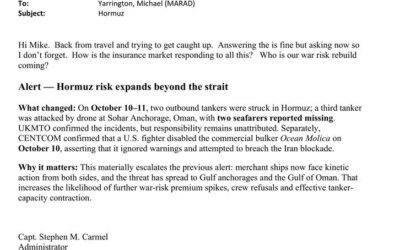
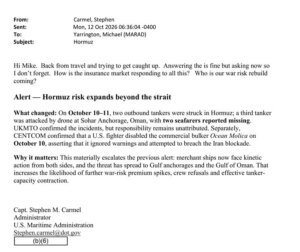
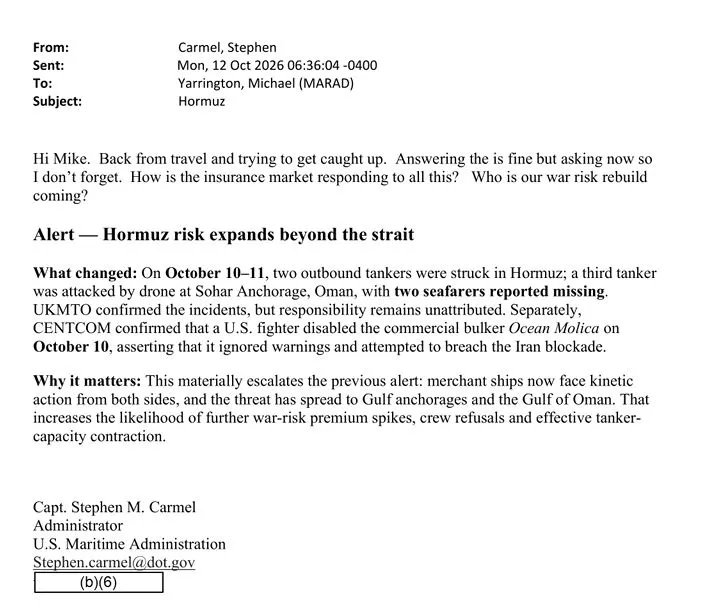
MARAD administrator Stephen M Carmel shared the alert with a subordinate on October 12, following CENTCOM’s attack on the vessel Ocean Molica and unattributed attacks on three other tankers in and around the Strait of Hormuz.
“Why it matters: This materially escalates the previous alert: merchant ships now face kinetic action from both sides, and the threat has spread to Gulf anchorages and the Gulf of Oman,” said the memo, titled “Alert – Hormuz risk expands beyond the strait”.
“That increases the likelihood of further war-risk premium spikes, crew refusals and effective tanker capacity contraction.”
Carmel shared the alert with MARAD colleague Michael Yarrington in an email requesting information about the impact of the attacks on insurance premiums and an update on the agency’s efforts to “rebuild” war risk insurance.
It is unclear whether the alert originated within MARAD or another agency.
“How is the insurance market responding to all this?” Carmel wrote to Yarrington, an official at MARAD’s Office of Marine Insurance.
Yarrington replied that a colleague had reached out to contacts in London for information and forwarded a summary of rising insurance premiums compiled from news reports.
Yarrington also shared a description of “core deliverables” considered crucial to MARAD’s work on war risk insurance, the details of which were redacted from the emails before their release.
Al Jazeera obtained the documents through a Freedom of Information Act request to MARAD, which is responsible for promoting the US maritime industry.

MARAD, which sits under the US Department of Transportation, the White House, the Department of Defence and CENTCOM, did not respond to requests for comment.
The emergence of the memo acknowledging the negative fallout of the blockade comes as a definitive end to the Iran war remains elusive after months of on-again, off-again negotiations between Washington and Tehran.
US President Donald Trump last week dismissed the need for a peace deal with Iran, days after suggesting that the conflict could end “fairly soon” and that renewed US strikes were “highly unlikely”.
“Those days have long since passed,” Trump wrote on Truth Social on Thursday. “We’ve got their money, Hundreds of Billions of Dollars, and we’ve got their Strait!”
Todd Huntley, a retired US Navy captain who leads the National Security Law Program at Georgetown University Law Center, said MARAD’s monitoring of the blockade was likely aimed at informing its advice to other branches of the US government.
“As far as I know, MARAD will issue general alerts on incidents or threats, but will not then discuss the consequences, eg, increases in insurance rates,” Huntley told Al Jazeera.
“I do think that some US officials either didn’t consider this risk or ignored it when ordering and implementing the blockade.
“To me, it was pretty obvious this was a likely development given past Iranian actions and threats.”
Ian Ralby, the CEO and founder of maritime security consultancy I.R. Consilium, said the Trump administration appeared to be less concerned about the “strategic considerations” of the blockade than preventing ships from contributing to Iran’s economic survival.
“The President has made it clear that he is unperturbed by the global economic fallout from the War – including the blockade – so it may also be the case that the potential consequences of the blockade were considered but dismissed as unimportant,” Ralby told Al Jazeera.

Global shipping has been roiled by attacks in the Strait of Hormuz and surrounding waters since the US and Israel launched strikes on Iran on February 28.
Some 130 attacks on vessels have been recorded in the region since the start of the conflict, resulting in the deaths of at least 25 seafarers, according to the International Maritime Organization (IMO).
October was the worst month for shipping since the war began, with 35 vessels targeted, according to the IMO.
While most attacks during the war have been blamed on Iran or Iranian-aligned forces, CENTCOM has claimed responsibility for destroying or disabling at least two dozen vessels, some of which it has identified as belonging to Iran’s Islamic Revolutionary Guard Corps (IRGC) shadow fleet.

The turmoil in the strait has sharply driven up costs for shipping lines.
The cost of insurance for an oil tanker carrying crude from the Middle East to East Asia surged about 200-fold from January to the end of October, reaching $12.29 per barrel, according to the Organization of the Petroleum Exporting Countries (OPEC).
As of July, insurers charged 3.5 percent–7.5 percent of a vessel’s market value for war risk cover, up from 0.10-0.25 percent before the war, according to industry estimates cited in the Parliament of Singapore, a major logistics and shipping hub.
Amid rising shipping costs, prices of crude oil and fertiliser have surged as much 60 percent and 112 percent, respectively, at various points during the war.
Boon Chuan Lim, an independent researcher in Singapore whose research on the turmoil in the Strait of Hormuz has been published in the Borsa Istanbul Review, said it was noteworthy that the Trump administration had placed enforcement of the blockade alongside other attacks when assessing disruption risk.
“A disabling strike adds a potential source of loss for vessels exposed to that enforcement, though the implications depend on each vessel’s circumstances,” Lim told Al Jazeera.
He added that danger was not limited to the narrow corridor in the strait.
“Geography matters, too,” Lim said. “Risk is not confined to the strait: Ships at anchor, bunkering or approaching ports can also be exposed.
“Insurance terms depend on the vessel, route, area and duration of exposure, so a wider threat can raise costs and complicate operations beyond the transit itself, but it does not mean every vessel faces the same additional premium.”
The Republicans’ crushing defeat in the US midterm elections on November 3 has been widely attributed to the fallout of the war, particularly higher fuel prices.
US Democrats achieved their best electoral performance in decades in a stinging rebuke of Trump ahead of the 2028 presidential election. Democrats have so far secured 56 seats in the 100-member US Senate and at least 257 seats in the 435-member House of Representatives.