 0
0
 0
0 We take care of the hearts of all people… Provide ‘professional psychological counseling’ to 1 million people by 2027
Full-scale implementation of the ‘National Mind Investment Project’ starting in July… Free for youth preparing for self-reliance, etc.
- Reporter nameReporter Park Hye-seon, Mobile Reporting Department
- Entered 2024.06.26 23:42
Starting in September, anyone can use SNS self-diagnosis… Expand mental health screening for young people starting next year
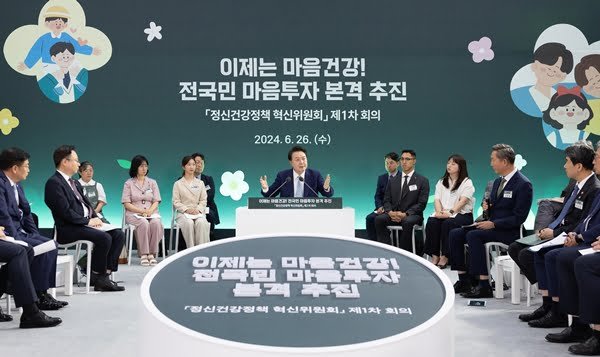
[Mobile Reporter Park Hye-sun] The government will begin full-scale implementation of the ‘National Mind Investment Support Project’ starting in July and provide professional psychological counseling to 1 million people by 2027.
This year and next year, we plan to increase mental health risk groups by 80,000 and 160,000 people, respectively, and expand it to the general public starting in 2026, adding 260,000 people in 2026 and 500,000 people in 2027.
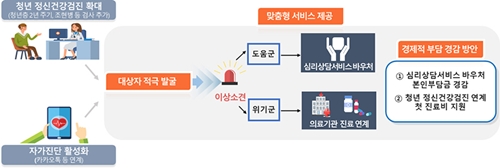
In particular, psychological counseling is provided a total of 8 times (equivalent to up to 640,000 won) to people with emotional difficulties such as depression and anxiety. However, out-of-pocket expenses are borne differently by 0-30% depending on income level, but the full amount is paid for young people preparing for self-reliance and children receiving extended protection. It’s free.
In addition, starting in September, anyone in the country will be able to use mental health self-diagnosis at any time through SNS (social networking service).
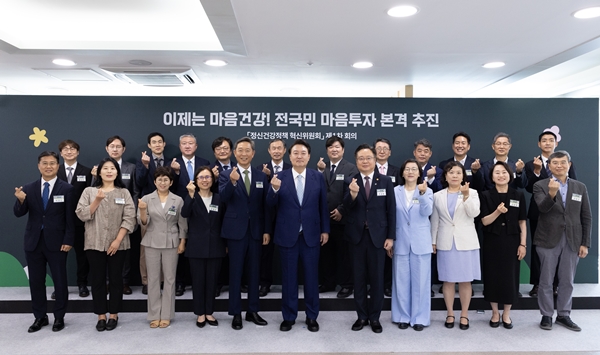
The Mental Health Policy Innovation Committee, launched on the 26th, held its first meeting presided over by President Yoon Seok-yeol and reported the ‘detailed implementation plan for mental health policy innovation plan’ and discussed operational plans for this content and plans for a campaign to improve mental health awareness.
The government declared a major change in mental health policy at the mental health policy vision declaration conference presided over by President Yoon Seok-yeol in December last year and announced that it would form a committee to discuss innovations in full-cycle policies in the mental health field.
Accordingly, for the launch of the Mental Health Policy Innovation Committee, the basis regulations were prepared, and after completing all necessary procedures, including the selection of members, a mental health policy innovation plan was announced.
This is the first government in history to launch a presidential committee in the field of mental health.
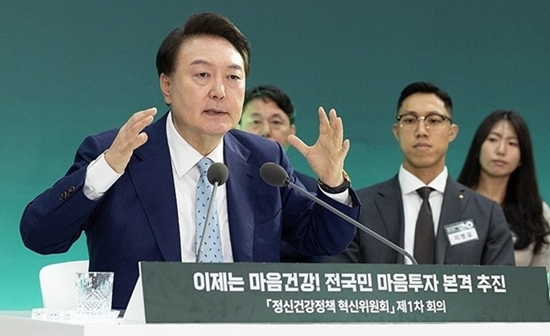
In his remarks, President Yoon emphasized, “It is important to detect and ‘prevent’ depression and anxiety in daily life so that they do not lead to mental illness.”
He then promised, “To this end, we will start the ‘National Mind Investment Project’ in July, where depressed and anxious citizens can receive psychological counseling from experts, and provide a psychological counseling service package to a total of 1 million people within the term.” .
◆ Establishment of a daily mental care system
Starting next year, mental health screenings for young people will be expanded, and student mental health screening tools will also be applied in earnest.
First, youth mental health checkups are conducted every two years (previously 10 years), early psychosis screening is added to depression screening, and first medical treatment costs are supported if necessary as a result of the screening.
In addition, we will introduce and expand the at-risk student screening test (Mind EASY test), which is used regularly, and reorganize the student emotional behavior characteristics test tool that is implemented every three years.
Mental health support in the workplace will be strengthened for office workers, and management for high-risk industries will also be activated.
In addition, the occupational trauma center will be expanded from the current 14 to 24 by next year, and the Employee Assistance Program (EAP) will be expanded through research.
In particular, the integrated suicide prevention counseling number 109 has been in operation since last January, and in September, SNS counseling will be introduced to take into account the characteristics of young people who prefer text conversations rather than phone calls.
To ensure smooth counseling operations, we plan to significantly expand the number of counseling personnel from 80 last year to 150 next year.
◆ Reorganization of mental emergency and treatment system
The government decided to establish a system that can quickly respond to mental emergencies.
First, the number of local crisis intervention teams will be expanded to 306, an increase of 102 from 204 last year, and 6 to 7 teams will be gradually supplemented according to regional demand.
Additionally, by 2028, the number of regional mental emergency medical centers will be expanded from the current 12 to 32, and the number of public psychiatric emergency beds waiting for mental emergency patients to be admitted will also be gradually expanded from 119 to 180 beds.
We also plan to develop and implement improvement plans for the rapid transfer of mental emergency patients.
Meanwhile, compensation for acute treatment will be made more realistic, and evaluation of mental health institutions will be improved to improve the quality of treatment provided by mental health institutions.
Accordingly, in 2026, an intensive care hospital system for acute mental illness will be introduced to make compensation for acute treatment more realistic, and social discussions on improving the hospitalization system at mental health institutions will also be promoted.
In addition, to manage the quality of mental health services, next year we will strengthen the management of institutions that fail the evaluation of mental health institutions and provide incentives to excellent institutions.
In particular, starting from the first half of next year, patients will be exempted from out-of-pocket medical expenses for long-acting injectable drugs, and a fee pilot project for use of day wards for less than 6 hours and hospital-based case management will be commercialized by 2027.
The addiction treatment infrastructure will be expanded to a tangible level. In order to provide treatment for each level of drug addiction, treatment and protection institutions will be divided into regional institutions and general institutions, and nine new regional addiction treatment institutions will be designated this year, increasing the number to 17 by 2029.
In addition, separate treatment fees and compensation fees that reflect the treatment difficulty and risk of addiction treatment will be established, health insurance will be applied for drug addiction treatment protection costs from August, and treatment cost support will be realized in stages.
The Addiction Management Integrated Support Center plans to expand from 60 this year to 85 next year.
◆ Innovation in welfare services for complete recovery
To ensure that mental rehabilitation services can be provided in all cities, counties and districts, the minimum number of mental rehabilitation facilities to be installed at the city/city level is proposed and the expansion of facilities is promoted.
However, in local governments where it is difficult to install mental rehabilitation facilities in a short period of time, we plan to first expand the recovery support project currently operated by 9 mental health welfare centers.
Job and housing support for the independence of people with mental illness will also be gradually increased.
Accordingly, support for welfare jobs for the mentally disabled began this year, and the project to develop and expand a specialized employment model for the mentally disabled will be a pilot project this year and commercialized next year.
In addition, a pilot project to support housing for independent living training for mentally ill people capable of self-management will be implemented starting next year and expanded to 100 units by 2030.
In addition, we will promote the elimination of insurance discrimination against mentally ill patients and expand procedural assistance during hospitalization and the public guardianship system.
To this end, measures will be put in place to promote the development and use of insurance products for people with mental illness, and inspections for cases of violations of the Insurance Business Act will also be strengthened.
Meanwhile, the government established the legal basis for procedural assistance and public guardianship to support the decision-making of mentally ill patients early this year, and starting this year, the procedural assistance project will be expanded nationwide and public guardianship will be reorganized to focus on specific guardianship.
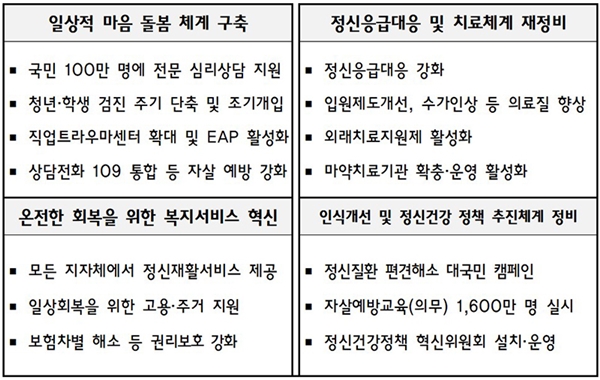
◆ Improving awareness and reorganizing mental health policy implementation system
Promote a campaign to eliminate prejudice against mental illness and minimize prejudice caused by media reporting.
Accordingly, a campaign expert committee within the Innovation Committee was formed to discuss campaign strategies and operation plans, and then a campaign was launched to dramatically improve the perception that ‘mental illness is incurable and dangerous.’
To minimize prejudice against mental illness issues, recommended standards for media reporting on mental illness will be established by the end of this year in cooperation with the Journalists Association, and the recommended suicide reporting standards 3.0 will be reorganized into suicide prevention reporting standards.
In particular, in order to implement mandatory suicide prevention education and spread mindfulness education in schools, suicide prevention education will be provided to 16 million people once a year starting in July.
In addition, mindfulness education, which helps students regulate their emotions and impulses and manage stress, is planned to be introduced next year after a pilot application in the second half of this year.
In addition, policy governance will be established by operating a mental health policy innovation committee, and organizations and personnel in charge of mental health policies and services will continue to be expanded.
To this end, we recommend that local governments establish an organization dedicated to mental health and suicide prevention, and continue to expand the manpower of mental health welfare centers and suicide prevention centers.
Furthermore, we plan to improve the overall mental health specialist system and expand the training of specialist staff.
In the future, the Innovation Committee will collect opinions from all walks of life on mental health policy innovation, while preparing a roadmap for implementing mental health policy innovation through consultation, establishment and coordination of policy directions, etc.
Accordingly, in order to promote a full-cycle mental health policy of prevention-treatment-recovery to daily life, an expert group including experts in each field, people with mental illness, and families bereaved by suicide was formed, and former President Yong Kim, former president of the World Bank, was appointed as a special advisor. .
In particular, based on the tasks discovered by the expert committee, we will continue to discuss medium to large-scale innovation measures related to mental health. Among the agendas selected as needing discussion by the main committee or agenda items submitted by ministries, we will discover and review matters that need to be brought up as agenda items. plan.
Shin Young-cheol, Chairman of the Mental Health Policy Innovation Committee, said, “Like building bricks one by one, I hope to build a solid foundation for mental health in our society.” He added, “Looking ahead 10 or 20 years, we can lay a solid foundation within the government’s term.” “I will work actively with all committee members to ensure this,” he said.
Reporter Park Hye-seon, Mobile Reporting Department ipneews@naver.com
Copyright © IPN News. Reproduction and redistribution prohibited.


