


Beyond apologies: Korean adoptees, families renew calls for government accountability
 0
 0

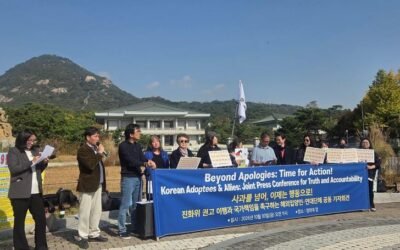
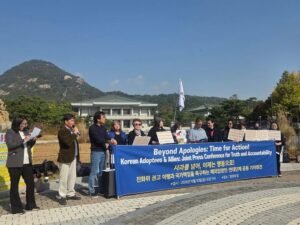
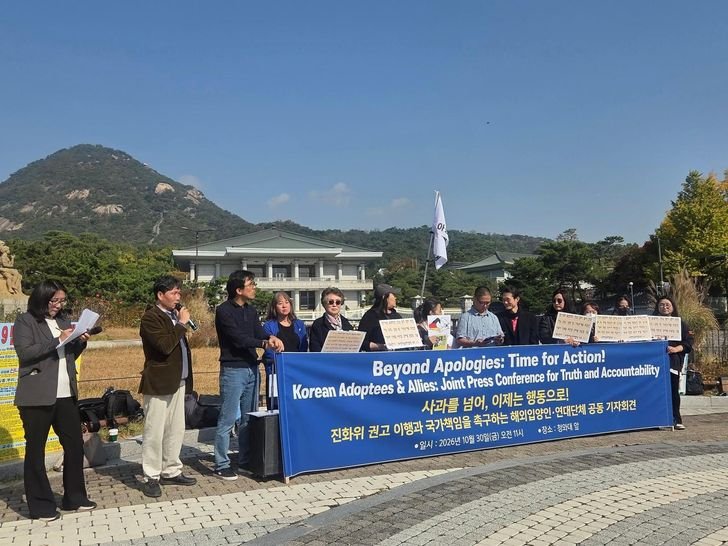
Overseas Korean adoptee organizations and Korean civil society groups call for the implementation of recommendations from the Truth and Reconciliation Commission and meaningful measures to restore the rights of those affected by overseas adoption during a press conference near Cheong Wa Dae in Seoul, Oct. 30. Courtesy of Cordula Kee-soon Jäger
Overseas Korean adoptees, Korean birth families and civil society organizations gathered outside Cheong Wa Dae in Seoul Oct. 30, calling on the government to address decades of human rights violations and family separations linked to intercountry adoption.
The press conference brought together overseas adoptee organizations and Korean advocacy groups in a united effort to seek accountability for past adoption practices and their lasting consequences for both adoptees sent abroad and families who remained in Korea.
The gathering came more than a year after President Lee Jae Myung apologized to overseas adoptees and their birth families in October 2025, following the findings by the Truth and Reconciliation Commission (TRC) of systemic human rights violations in Korea’s overseas adoption practices.
Despite apologies and kind words given toward those whose rights have been violated by international adoption, those who gathered at Cheong Wa Dae argued that official acknowledgment has yet to result in meaningful assistance or accountability.
Choi Hyung-suk, head of Korean Unwed Mothers Family Association, an organization advocating for unmarried mothers, read a statement emphasizing that support is needed for adoptees, and those found to be victims of acknowledged human rights violations have yet to receive compensation or meaningful redress.
The statement urged the government to move beyond expressions of regret and establish measures addressing the consequences of wrongful adoptions and family separations.
Families continue searching for answers
One of the attendees was Han Tae-soon, whose daughter Shin Gyeong-ha went missing 1975. She described the devastating impact of discovering that her child had been illegally sent abroad for adoption without her consent. Although she eventually located her daughter, Han said the discovery raised further questions about the state’s responsibility for separating her family.
She called for a thorough investigation and stronger safeguards to prevent similar violations.
Other participants described the difficulties of searching for biological relatives with little or no reliable documentation.
Jelle Ga, an adoptee living in Sweden, said he was born in 1973 but has no information about his biological parents. Park Gi-soon, adopted to Germany, expressed uncertainty about whether the name recorded in her adoption documents was even her original identity.
Their experiences underscored concerns surrounding incomplete, inaccurate or potentially falsified adoption records, which can complicate family searches decades after an adoption.
Demands for institutional reform
The joint demands presented at the press conference called for guaranteed access to adoption records, expanded family search assistance, implementation of the TRC’s recommendations and meaningful remedies for victims.
They called for the implementation of recommendations by the TRC, concrete measures to restore adoptees’ and victims’ rights, family reunification assistance and remedies for victims of past adoption abuses.
Advocates also emphasized the importance of public education about Korea’s overseas adoption history and stronger government accountability for past institutional failures.
They proposed a dedicated special commission to establish a coordinated mechanism for additional truth-finding efforts, remedies and institutional reform, with adoptees and affected families participating in decisions about their implementation.
Such measures would address concerns that existing systems remain fragmented, leaving individuals to navigate government agencies, adoption organizations and legal procedures independently.
The participation of Korean organizations also broadened the discussion beyond overseas adoptees to include birth parents, siblings and families affected by adoption-related separations.
Following the press conference, representatives delivered their joint statement to the presidential office, seeking government response to their demands.
Renewed pressure following IKAA Gathering
The event came a little over a week after the International Korean Adoptee Associations (IKAA) Gathering, held in Seoul Oct. 19–24 with more than 600 Korean-born adoptees attending from all around the world. First lady Kim Hea Kyung made a historic appearance at the gathering’s opening ceremony, renewing attention to adoptee rights.
While her attendance offered recognition and visibility, participants questioned whether symbolic gestures would lead to substantive policy changes.
For adoptees and birth families still searching for one another, time remains a central concern. As parents and other relatives age, opportunities for reunification and recovering firsthand information can disappear permanently.
Advocates from Korea and abroad continue to emphasize that meaningful reform requires not only recognition of historical injustices but also accessible support systems, transparent procedures and the direct participation of affected communities.
For adoptees and Korean citizens affected by decades of separation, the question is no longer simply whether Korea recognizes past wrongdoing, but whether its institutions will provide the information, support and remedies necessary to address its continuing consequences.
Antonia Giordano is a freelance photographer and writer based in Seoul. An adoptee, Antonia deeply understands and connects with the issues surrounding adoption and post-adoption. Visit giordanoantonia.myportfolio.com and follow @antonia_creative_services on Instagram.