






Korea’s largest game show G-STAR at crossroads as top studios look abroad
 0
 0

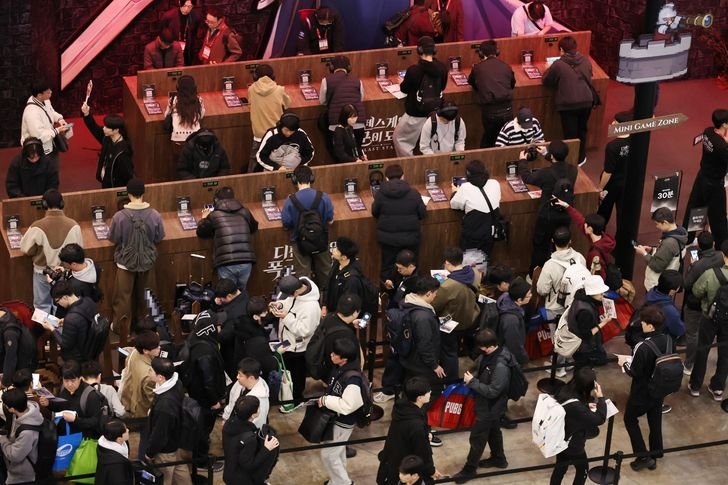
Visitors enjoy new titles at the G-STAR game convention held in Busan, Thursday. Yonhap
Launched in 2005, G-STAR has been widely considered a barometer of South Korea’s gaming industry, giving developers a stage to debut upcoming titles, and facilitating cross-border exchanges between local studios and overseas publishers.
Despite ups and downs, including a complete cancellation during the COVID-19 pandemic, the annual event has maintained its reputation as South Korea’s flagship game fair.
After two decades, however, the event is now at a crossroads. Despite efforts to expand its scope into other sectors, such as webtoons and motor racing, major domestic game companies are turning away from the event and visitor numbers are declining.
Three of the country’s biggest game companies — NC Corp., Netmarble Corp. and Nexon Games Co. — were absent from this year’s G-STAR, which kicked off its three-day run in the southeastern port city of Busan on Thursday.
Nexon and NC served as the event’s main sponsors in 2024 and 2025, respectively.
It marked the first time the three game giants bypassed the event since 2021, when the country was reeling from the COVID-19 pandemic.
Krafton Inc., the publisher behind the megahit PUBG: Battlegrounds franchise, was the only major South Korean company to operate a large booth this year, according to the event’s organizers.
“I was looking forward to seeing Nexon this year, since I am a fan of the MapleStory game, but was disappointed that the company did not come,” a 28-year-old attendee surnamed Lee said.
Overall participation has also been in decline.
A total of 1,237 companies from 41 countries participated in the event this year, according to a preliminary count released by the event’s organizers on Wednesday.
This is fewer than the 1,273 companies from 44 nations recorded in 2025, when the number of exhibitors and visitors posted its first drop since the COVID-19 pandemic.
Industry insiders pointed out that the slump comes as local companies increasingly shift their commitments to overseas exhibitions.
Kakao Games Corp. and Pearl Abyss Corp. unveiled their new titles at the Gamescom convention held in Cologne, Germany, in August.
Nexon Games chose Japan instead of South Korea, introducing the Korean-language demo of the upcoming subculture mobile game Pareidolia at the Tokyo Game Show in September.
G-STAR’s organizers made concerted efforts to revamp the event this year, bringing in fresh participants such as Hyundai Motor Co., but could not reverse those companies’ departures.
“Generally, I am used to the first day being much more crowded, but (this year) it is much lighter,” said Yulia Chernyshevskaya, a marketing executive at a Russian game distributor, which has long-standing relationships with South Korean game companies, such as NC.
“Last time I was here, two years ago in 2024, it was much more crowded, especially on the first day,” she added.
Culture Minister Chae Hwi-young acknowledged growing concerns over the event, and pledged strong government support to help develop G-STAR into a globally recognized game exhibition.
“There seems to be some disappointment that G-STAR, considered the industry’s flagship event, is seeing a number of major game companies pulling out,” he said following a tour of the event venue.
“I will gather ideas and provide support to develop the event as a world-class gaming show that commands more attention,” he added.