





‘Can I see my mother?’ Korean War veteran recalls American soldier’s plea
 0
 0

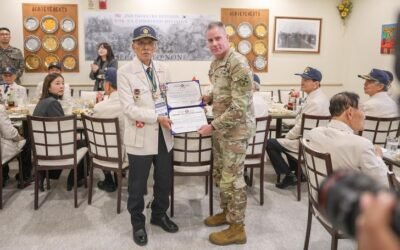
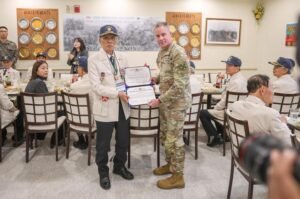
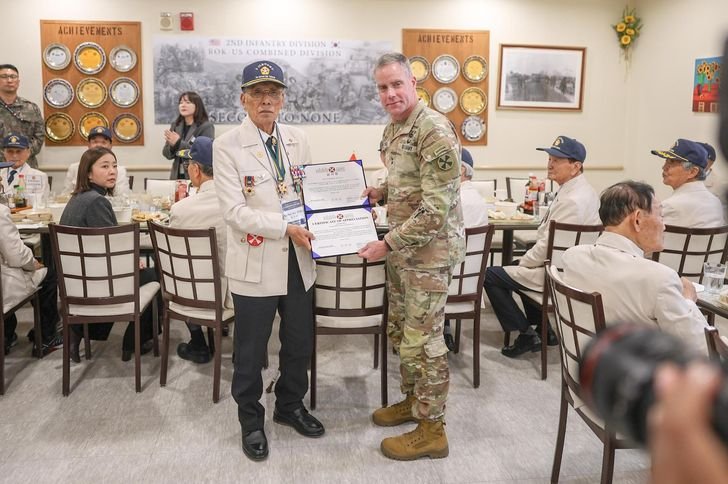
Korean War veteran Kang Ku-kon, left, receives a certificate of appreciation during a luncheon and gift presentation ceremony at the Eighth Army’s Talon Cafe at Camp Humphreys in Pyeongtaek, Nov. 5. Courtesy of Ministry of Patriots and Veterans Affairs
PYEONGTAEK, Gyeonggi Province — “Can I see my mother?”
More than seven decades later, Korean War veteran Kang Ku-kon still remembers those five words spoken by a young American soldier fighting for his life.
The soldier, barely 19, had suffered a severe abdominal wound less than a week after arriving in Korea. Kang, who was helping at a U.S. Army field hospital, was just 15 himself when he went to serve in the 1950-53 Korean War.
During a visit to the U.S. Eighth Army headquarters at Camp Humphreys in Pyeongtaek, Gyeonggi Province on Nov. 5, Kang recalled his years with American soldiers.
Kang spent part of his childhood in Japan, where his father ran a construction business. He learned to ride horses at an early age but also witnessed American bombing raids during World War II. By the time war broke out in his own country, he already knew how devastating it could be.
In 1950, Kang fled his rural hometown in Yeongdong, North Chungcheong Province, for the southeastern city of Daegu by train. There, he saw dozens of wounded soldiers being brought to an army hospital every day.
Shocked by what he saw, Kang volunteered for military service with his friends.
“My parents would have stopped me if I’d told them. So I went without telling them,” he said.
After a few days of military training in Busan, Kang went into battle. The little English he had learned at school helped him join an American unit.
He later assisted military doctors at an Eighth Army field hospital, fetching bandages and other medical supplies.
“I could usually tell what they needed. They’d be pleased when I brought them the right things. They often told me I was smart,” he said.
Kang also remembers an American sergeant who looked out for him. A World War II veteran, the sergeant kept fighting even after being shot in the shoulder.
“Even as a boy, I felt grateful to those Americans and sorry for them. They had come to help our little country and were making such sacrifices,” he said.
The trip to Camp Humphreys was Kang’s first visit to a U.S. military base since completing his military service.
Today, he hands out booklets about the war whenever he meets students, telling them about his own experiences.
But throughout the interview, Kang kept returning to the story of the wounded American soldier.
He had reassured the young man that he would survive and see his mother again.
Kang wishes they had had enough time to exchange addresses. Perhaps then he could have found out what happened to him. But at the time, bullets were flying past his ears.
He never found out whether the soldier made it home.
“I don’t think he survived,” Kang said. “I still think about him.”