









More Koreans say people should marry, but money remains top barrier
 0
 0

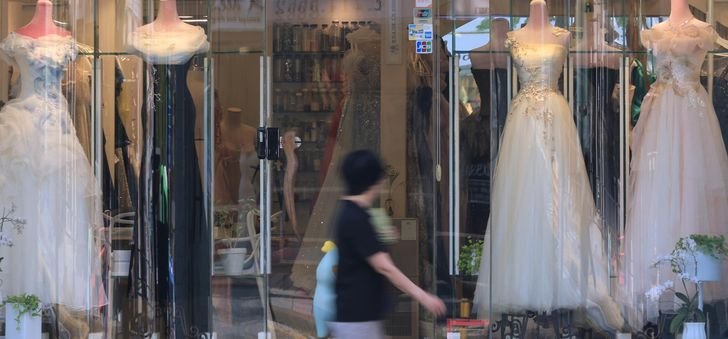
A pedestrian walks past a bridal shop in Seoul, Oct. 12. Yonhap
Kim, a 41-year-old office worker in Seoul, is getting married this month. As he had remained single longer than many of his peers, his parents began to worry that he might never marry. But Kim had never thought of marriage as something he would forgo.
“People may be more skeptical about marriage these days, but I’ve never thought I’d stay single,” he said. “I wanted an ordinary life with a spouse and children, and I wanted that sense of stability. To me, an ordinary life is happiness.”
With Seoul home prices out of reach, Kim and his partner opted for a jeonse rental, which requires a large upfront deposit. Even then, they barely managed to cover the deposit with help from both sets of parents.
“Housing takes up most of what it costs to get married,” Kim said. “We cut back on the dress, the suit and the jewelry to put more toward housing. Even after all that, we’re still nowhere near being able to buy a place.”
The 2026 Social Survey, released Wednesday by the Ministry of Data and Statistics, found that 55 percent of respondents aged 13 and older said marriage was either advisable or essential. The figure was up 2.5 percentage points from two years earlier and was the highest since 2014, when it stood at 56.8 percent.
Overall, 60.2 percent of men and 49.8 percent of women said people should marry, a gap of 10.4 percentage points. Among those who had never married, the figures were 43.9 percent for men and 29.9 percent for women, up 2.3 and 3.9 percentage points, respectively, from two years earlier. The gap narrowed by 1.6 percentage points to 14 points.
The share of respondents who said married couples should have children rose 1.8 percentage points to 70.2 percent, while the average number of children respondents considered ideal remained at 1.89.
Some 67.8 percent said it was acceptable for couples to live together without marrying, and 38.1 percent said it was acceptable to have children outside marriage. Both figures have risen steadily since 2012.
Financial constraints remained the most commonly cited reason for not marrying, at 29 percent. The share citing job insecurity rose from 12.9 percent to 15.5 percent, overtaking the burden of having and raising children, which was cited by 12.5 percent.
Asked which policy would be most effective in addressing Korea’s low birthrate, 32 percent chose housing assistance and 25.7 percent chose job creation and employment support for young people. Compared with two years earlier, the share choosing housing assistance fell 1.4 percentage points, while the share choosing job measures rose 4.9 points.
Housing and job support drew nearly equal backing among respondents in their 20s, at 31.3 percent and 30.6 percent, respectively. Among those in their 30s, housing assistance drew more than twice as much support as job measures, at 37.4 percent versus 18.2 percent.
The survey also found that 37.8 percent of respondents considered Korean society safe, up 8.9 percentage points from 2024 and nearly triple the 13.2 percent recorded in 2016. The share who considered society unsafe fell from 25.6 percent in 2024 to 18.8 percent.
Asked to assess safety in specific areas, 61 percent said they felt unsafe with regard to personal data leaks, 42.1 percent said the same about cybersecurity threats such as hacking and computer viruses and 39.5 percent about crime.
Crime was the most commonly cited threat to public safety, chosen by 22.4 percent of respondents, up 4.5 percentage points from 2024. National security ranked second at 17.6 percent, followed by economic risks at 15.7 percent.