








THE weighs halving citation impact share to 7.5% in 2028 rankings
 0
 0

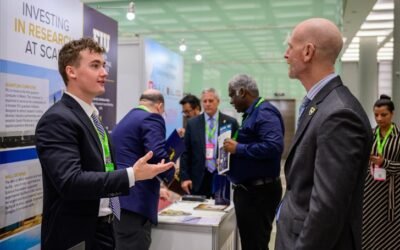
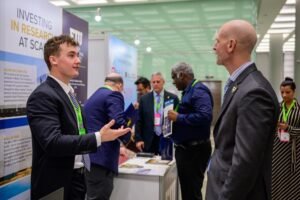
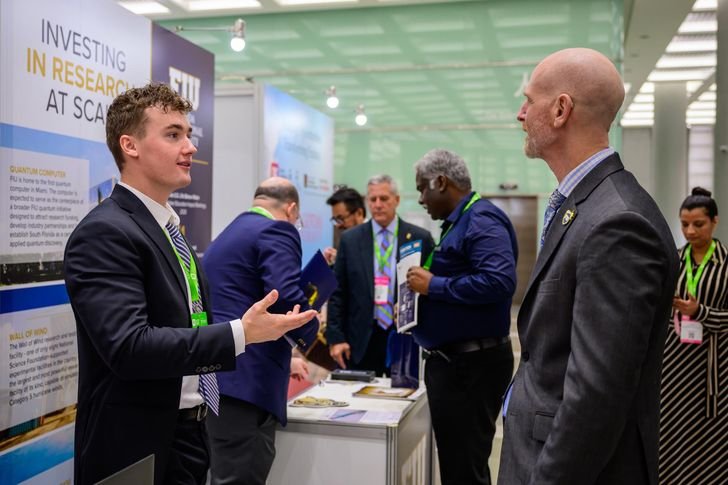
Participants talk at a booth during the Times Higher Education (THE) Innovation & Impact Summit 2026 at Korea University in Seoul, Wednesday. Korea Times photo by Choi Won-suk
Times Higher Education (THE) is considering halving the weight of citation impact in its 2028 World University Rankings, a move that could benefit Korean universities struggling in the indicator.
Under the proposed changes, four indicators measuring research quality — citation impact, research strength, research excellence and research influence — would each account for 7.5 percent of a university’s overall score.
The proposal would halve citation impact’s current weighting of 15 percent while raising the other three indicators from 5 percent to 7.5 percent each, keeping the overall weight of research quality unchanged at 30 percent.
Puden Tsang, THE’s regional director for Japan, Malaysia, South Korea and Thailand, outlined the proposal Wednesday during a data masterclass at the THE Innovation & Impact Summit 2026.
The changes have yet to be finalized, with THE seeking feedback from universities and conducting further testing before confirming its 2028 methodology.
The proposed changes aim to ensure a fairer, more balanced assessment of universities’ research performance by reducing the influence of a small number of highly cited papers.
“Whenever you take the average of something, it means that you just need maybe one or two highly cited papers and then your average, your score, goes up,” said Mei Mei Lim, THE’s president for the Asia-Pacific region.
Under the current methodology, citation impact is measured using mean field-weighted citation impact (FWCI), which compares how often research papers are cited with similar publications worldwide.
Because the measure relies on an average, a handful of exceptionally highly cited papers can significantly boost a university’s score without reflecting the performance of its broader research output.
“What we want to do is to try to have a fairer, more balanced approach,” Lim said, explaining the proposed shift toward equal weighting across the four research quality indicators.
“That in a way would have a positive impact on Korea,” Lim said, explaining that the reduced weighting would limit the effect of weak citation scores.
According to data presented during the session, FWCI and international co-authorship remain two of the weakest areas for Korean universities.
Beyond research performance, THE’s analysis showed that Korean universities are improving more slowly than their regional peers.
Their overall rankings scores rose 1.2 percent year-on-year, lagging behind neighboring countries such as Japan and China, which recorded gains of 3.4 percent and 2.8 percent, respectively, as well as Hong Kong at 1.9 percent.
While the number of Korean universities in the rankings increased from 36 in 2022 to 44 in 2027, most of the growth came from institutions in the middle and lower tiers, with the number in the global top 200 remaining unchanged at six.
The findings underscore the challenge facing Korean universities in translating broader participation in global rankings into stronger international competitiveness.