









[ED] Specter of another Yalta overstated
 0
 0

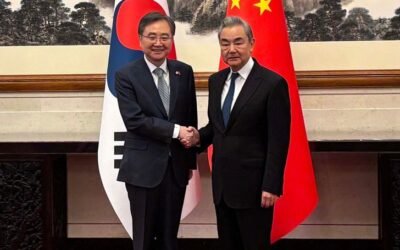
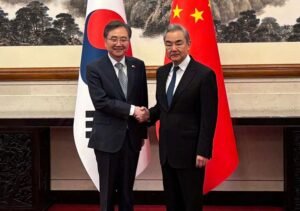
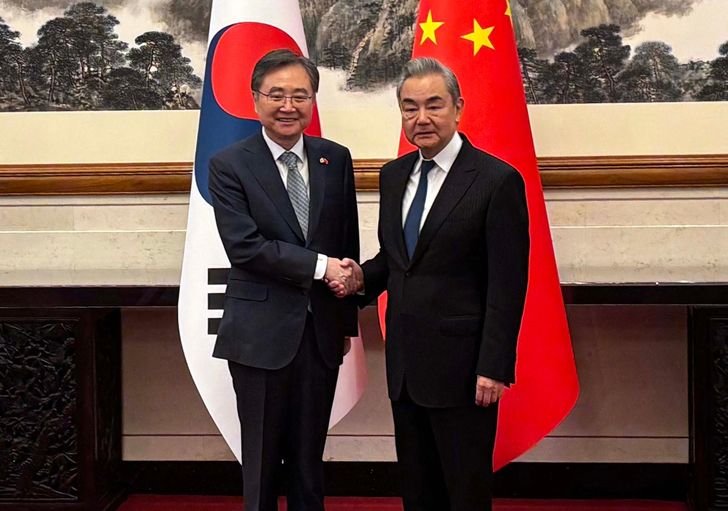
Foreign Minister Cho Hyun, left, shakes hands with Chinese Foreign Minister Wang Yi before a meeting held in the Diaoyutai State Guesthouse in Beijing, Friday. Yonhap
The specter of the Yalta Conference is haunting Korea as the Asia-Pacific Economic Cooperation (APEC) summit approaches. Such concerns reflect either a victim mentality or diplomatic overstatement.
During a recent meeting with a Chinese official, a high-ranking South Korean official reportedly expressed concern that an upcoming trilateral summit among the U.S., China and Russia, to be held on the sidelines of the APEC summit, should not turn into another Yalta Conference. The original Yalta talks were held in 1945 among the so-called Big Three world powers: the U.S., the United Kingdom and the Soviet Union.
At the time, the three powers agreed that Korea, then under Japanese colonial rule, would be placed under a multilateral trusteeship before gaining full independence from Japan. In the years that followed, Korea was divided into two, with the South placed under U.S. military administration and the North under Soviet military administration. Korea had no voice in the process, and its fate was determined by the major powers of the time.
On Saturday, the foreign ministry official told reporters that he had raised concerns about the potential consequences of the U.S.-China-Russia summit for South Korea during separate meetings with his American and Chinese counterparts. “I explicitly told my Chinese counterpart that the U.S.-China-Russia summit should not become another Yalta Conference,” he said, speaking on condition of anonymity.
Although he did not elaborate on what prompted his concern, he appeared to be worried about the possibility of the three countries reaching a consensus or agreement on North Korea, particularly regarding its nuclear status.
As a diplomat, he was arguably doing his job by bringing up a potential threat to South Korea’s vital national interests. In this case, his purpose appears to be preventing North Korea from gaining international recognition as a nuclear weapon state. In that sense, his warning is legitimate.
Whether his judgment was appropriate, however, is another matter.
His fear of a repeat of Korea’s tragic history appears exaggerated, if not unrealistic.
Experts believe symbolism, rather than substance, will dominate the trilateral summit, with little chance of a treaty or formal agreement emerging from the meeting. The U.S., China and Russia have different strategic calculations and expectations.
According to the White House, U.S. President Donald Trump will prioritize reducing nuclear weapons and preventing their proliferation. China, meanwhile, sees the summit as an opportunity to showcase its diplomatic influence as the host country. Russia is arguably the biggest beneficiary of the meeting, as it will reinforce Moscow’s status as a major global power on par with Washington and Beijing, despite its ongoing invasion of Ukraine and the international sanctions imposed in response.
How could three countries with such different priorities and expectations possibly reach a substantive agreement?
It also remains unclear whether abandoning denuclearization as the ultimate goal for North Korea would serve the vital interests of China and Russia. Both countries share borders with North Korea. Would either feel comfortable with a neighboring state possessing a nuclear arsenal?
There is another, more serious problem revealed by the foreign ministry official’s remarks about North Korea’s nuclear weapons. He made clear that arms reduction talks with North Korea would hurt South Korea because they could effectively allow Pyongyang to retain its existing nuclear arsenal.
The diplomat’s position stands in stark contrast to that of President Lee Jae Myung. Lee has repeatedly pointed out that North Korea already possesses dozens of nuclear weapons and that its arsenal will continue to grow unless effective measures are taken. He has suggested arms reduction talks as a realistic way to freeze North Korea’s nuclear program and prevent further expansion of its arsenal.
The apparent divergence between Lee and the senior foreign ministry official raises a fundamental question: What exactly is South Korea’s official position?
Inconsistent messaging on a critical issue such as North Korea’s nuclear program risks confusing South Korea’s ally and partners, undermining efforts to build a coordinated international response.
South Korea is no longer the country it was in 1945. Back then, Korea was a colony without sovereignty and had no means of making its voice heard, even on decisions that would ultimately determine its fate. Today, South Korea is one of the world’s most dynamic economies and an influential member of the international community. It has both the standing and the means to make its voice heard.
South Korea’s future will be determined by the choices it makes today, not by agreements or treaties struck by other countries behind its back. To ensure that, Seoul must send a clear and consistent message to the international community on key issues, particularly North Korea’s nuclear program.