













Experience-first hiring leaves more young Koreans in irregular jobs
 0
 0

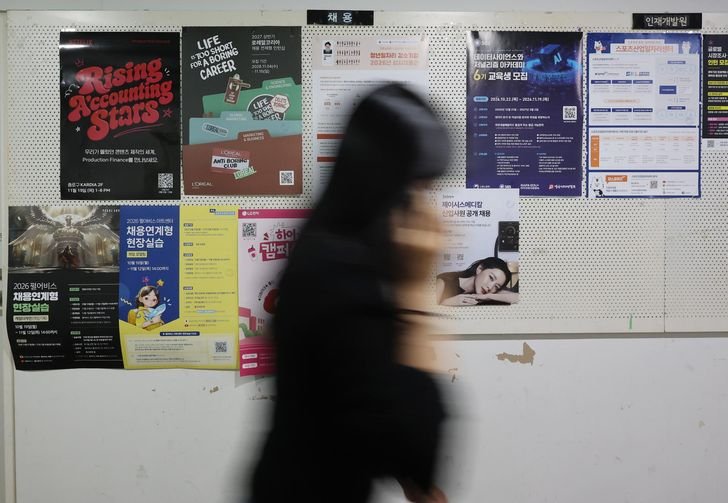
A student walks past a job listings board at a university in Seoul, Nov. 11. Yonhap
For Son Ga-hyun, who managed to land a job in textbook development after years of searching, job hunting in Korea had been a slow grind with little to show for it.
“Entry-level openings were few and far between, and even internships would be packed with applicants with substantial work experience,” she said. “So even when positions were technically open to candidates with and without experience, I felt I never really stood a chance competing against people who had already spent years in the workforce.”
For nearly two years, the 27-year-old relied on part-time teaching jobs to make ends meet.
Her experience reflects a broader struggle among young job seekers in the country, where nearly half of young wage earners now work in irregular positions.
As of Aug. 31, irregular workers accounted for 46 percent of wage earners aged 15 to 29 — the highest ratio recorded by the Ministry of Data and Statistics since it began compiling the data in 2003. The figure was considerably higher than the 38.5 percent recorded among wage earners of all ages.
The trend points to a changing hiring culture that is making it more difficult for young people to secure stable jobs. In a cooling economy, an increasing number of companies are gravitating toward candidates who can step into a role with little training over those they would need to develop from the ground up.
A 2026 survey of 500 companies with at least 100 employees, conducted by the Korea Enterprises Federation, found that 67.6 percent of respondents ranked relevant work experience as the most important of seven criteria they considered when hiring new recruits.
“So what companies really want these days are ‘pre-experienced rookies,’” Son said. “It’s a system where you can’t build experience because no one gives you the chance in the first place.”
Hong Sok-chul, an economics professor at Seoul National University, said the preference for experienced hires reflects both employers’ business needs and changes in the labor market.
“From an employer’s perspective, experienced workers are simply more productive. That preference has always existed,” he said. “What’s changed is the applicant pool. People no longer expect to spend their entire careers at one company. They move between jobs to advance their careers, and as a result, the pool of applicants itself has become more experienced. Companies are responding to that.”
The pressure on young job seekers is also reflected in the broader employment figures. While Korea added 139,000 jobs overall last month, the number of employed people aged 15 to 29 fell by 196,000 from a year earlier, marking the 48th consecutive month of decline.
“Youth employment has continued to decline partly because companies are moving away from large-scale open recruitment toward rolling, position-specific hiring,” said Bin Hyun-joon, director general of social statistics at the Ministry of Data and Statistics.