














‘I’d rather stay an intern’: Why some Gen Z workers in Korea are choosing less responsibility
 0
 0

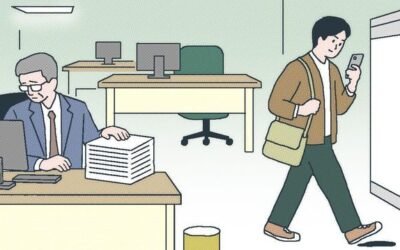
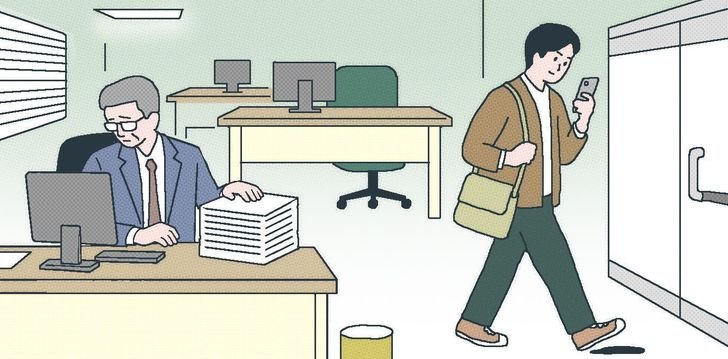
Korea Times illustration by Shin Dong-jun
For some young Korean workers, leaving the office on time matters more than finishing every task, and avoiding the responsibilities of a permanent position can be more appealing than climbing the corporate ladder.
These attitudes are emerging among members of Generation Z, who are challenging workplace expectations long shaped by loyalty, overtime and deference to senior colleagues.
In a roundtable discussion organized by the Hankook Ilbo, young participants shared their views on work, career advancement and workplace relationships, revealing both generational differences and contradictions in their own approaches to professional life.
Their experiences suggest that while younger employees increasingly demand clearer boundaries and more explicit instructions, they sometimes struggle to meet those same expectations when they become responsible for guiding others.
Leaving work on time, even with tasks unfinished
For Korea’s Generation X, now largely in their 50s, staying late at the office was once considered a badge of dedication.
In her 2000 novel “A Very Old Joke,” acclaimed Korean author Park Wan-suh portrayed a workaholic who took pride in looking up at the illuminated windows of an office building, finding reassurance in the belief that working longer hours meant getting ahead.
That culture, in which company loyalty and voluntary overtime were widely valued, stands in contrast to the attitudes expressed by some of today’s younger workers.
One participant said four out of five friends they had asked would refuse to work overtime voluntarily, even if they had unfinished tasks.
“Some think it’s the company’s fault for assigning work that can’t be completed during regular hours,” the participant said. “They don’t want to accept a culture where overtime becomes the norm.”
Another participant questioned whether the problem might sometimes lie with the employee rather than the employer.
“Couldn’t it be a matter of their own ability rather than the company’s fault?” the participant asked.
The first participant said those workers generally believe they are doing their best but are continually being assigned more work.
Others said the situation depends heavily on the industry and the nature of the job.
One participant said a friend working in web design stays late when necessary because missing a deadline would ultimately create more problems.
Another, whose job involves laboratory experiments, said leaving an experiment unfinished simply because the workday had ended was not an option.
“I stayed about 30 minutes late today because an experiment ran longer than expected,” the participant said.
A third participant said taking responsibility for one’s own work was important but questioned managers who routinely assigned workloads that could not reasonably be completed without overtime.
Some participants also acknowledged that proper overtime compensation could make employees more willing to stay late.
The clash over workplace initiative
Another source of tension is what Korean workplaces often call “work sense,” or the ability to anticipate what needs to be done without explicit instructions.
One participant described a friend who, on the second day of an internship, attended a first face-to-face meeting with a supervisor.
Instead of receiving specific instructions, the intern was told, “Try to figure out what kind of work you should be doing here.”
The intern found the instruction vague and irresponsible.
“Some of my friends think giving clear instructions is part of a supervisor’s job, and that’s one reason supervisors are paid more,” the participant said.
Another participant questioned the fairness of expecting newcomers to demonstrate initiative before they had accumulated sufficient experience.
“Being able to do more than you’re told comes from years of experience and knowledge,” the participant said. “It’s unreasonable to expect that from new employees.”
Taking initiative can also create risks, the participant said, because employees may be held responsible if something goes wrong.
“I think making a mistake while doing something you don’t fully understand is worse than being criticized for lacking initiative,” another participant said. “So my friends and I tend to do exactly what we’re told.”
Not everyone agreed.
One participant said new employees generally do not carry enormous responsibility, while another argued that unfamiliar assignments can provide valuable learning opportunities.
However, the latter said supervisors should first create an environment where mistakes are accepted as part of the learning process.
“It would help if they said, ‘It’s OK to make mistakes. Just approach it as a learning experience,'” the participant said.
Disagreements also emerged over how supervisors should check whether junior employees understand instructions.
One participant suggested that instead of simply asking, “Do you understand?” supervisors could ask newcomers to explain what they had understood.
Another immediately objected.
“That feels like being tested. I’d find it unpleasant,” the participant said.
Others said the acceptability of such questions depends on their frequency, tone and the overall workplace atmosphere.
Artificial intelligence (AI) has also changed how younger workers seek help.
One participant said a friend now turns to AI first when encountering technical questions rather than immediately asking a senior colleague.
“Even when someone tells you to feel free to ask questions, it’s hard to take that literally,” another participant said. “You know everyone is busy and under pressure. You want to figure out as much as possible yourself and only ask questions that the supervisor alone can answer.”
Why some would rather remain interns
The discussion also revealed a dilemma surrounding promotion and career advancement.
While higher positions bring greater authority, they also come with more responsibility — something not every young worker wants.
“One of my friends said they’d rather keep working as an intern to avoid that responsibility,” a participant said. “If making a lot of money isn’t the goal, they’d prefer to stay in a position with fewer responsibilities.”
Another participant said their own attitude toward career advancement had changed.
They had initially hoped for a conventional career path in which salary and responsibilities gradually increased.
But after realizing their current workplace did not offer that kind of structure, they decided it would be better to broaden their skills and take on more substantial assignments while they still had opportunities to learn.
Others suggested that employees who view their current jobs as stepping stones to other companies may have little incentive to develop strong emotional attachments to their workplaces.
Some may simply want to collect their paychecks without taking on additional responsibilities.
When Gen Z workers become the ones giving instructions
The discussion took an ironic turn when participants considered how they behaved after moving into positions where they had to train colleagues or hand over responsibilities.
One participant said they had prepared detailed handover documents before leaving a previous job because they remembered how difficult it had been to obtain information from senior colleagues when they first joined.
Another admitted falling short of the standards they had once expected from others.
“When I was learning the job, I wished there had been proper documentation,” the participant said. “But once I was the one responsible for teaching someone else, I found I didn’t have enough time, and honestly, it was a hassle.”
The participant said preparing handover documents kept getting postponed because the task did not directly contribute to immediate performance evaluations or results.
“I realized that was one of my own limitations,” the participant said.
Another participant suggested that the problem reflected a broader organizational weakness rather than simply individual negligence.
Companies should have established proper documentation systems in the first place, the participant said.
The employee who had struggled with preparing handover materials agreed, saying they had asked the company to provide such a system but were instead told to create it themselves.
“That really took the wind out of my sails,” the participant said.
This article from the Hankook Ilbo, the sister publication of The Korea Times, was translated by a generative AI system and edited by The Korea Times.