










Conflicting brokerage forecasts deepen investor confusion
 0
 0

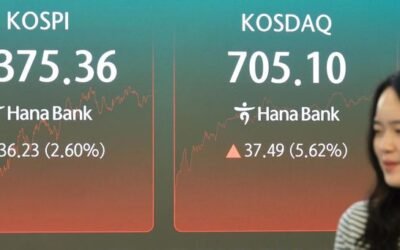
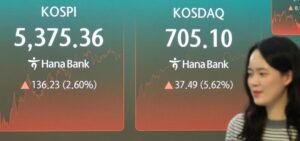
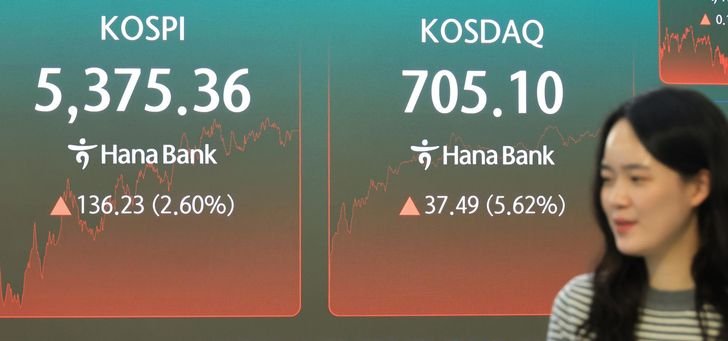
Stock indexes are displayed on a screen at Hana Bank’s headquarters in Seoul, Wednesday. KOSPI closed up 136.23 points, or 2.60 percent, at 5,375.36, while Kosdaq jumped 37.49 points, or 5.62 percent, to finish at 705.10. Yonhap
Lim, a 44-year-old resident of Guri, Gyeonggi Province, began investing actively in Korean stocks last year, regularly reading brokerage research reports to help guide her investment decisions.
But as brokerages have increasingly issued conflicting market forecasts and frequently revised their price targets, she has grown uncertain about which reports to trust.
“These days, brokerages’ forecasts vary so widely and price targets change so frequently that I don’t know which ones to believe,” Lim said. “Now, I sometimes turn to people around me or ask artificial intelligence (AI) tools for advice instead.”
Lim is among a growing number of retail investors struggling to make sense of brokerage research as domestic and foreign securities firms repeatedly revise their market outlooks and stock price targets amid sharp swings in the benchmark KOSPI.
KOSPI broke through the 9,000 mark for the first time on June 18, closing at 9,063.84, but has since tumbled into the 5,000 range. Some brokerages that predicted the index would reach 10,000 in June have lowered their forecasts by more than 4,000 points in just five months.
On Wednesday, KOSPI rose more than 2 percent despite growing expectations that the U.S. Federal Reserve could raise its benchmark interest rate by 50 basis points. The index opened 0.56 percent lower but reversed its losses to close up 136.23 points, or 2.60 percent, at 5,375.36. The tech-heavy Kosdaq also gained 37.49 points, or 5.62 percent, to finish at 705.10.
In the Seoul foreign exchange market, the won strengthened by 3.9 won to close onshore trading at 1,333.6 won per dollar.
Rather than anticipating market trends, domestic brokerages have largely adjusted their price targets in response to market movements, raising them during rallies and lowering them after sell-offs.
Data from financial information provider FnGuide showed that reports raising stock price targets outnumbered those lowering them by 8.6 to 1 in February, when KOSPI was on an upward trajectory.
That pattern reversed for the first time this year between July 1 and 16, when downward revisions outnumbered upward adjustments. The shift came amid a sharp market downturn, with KOSPI plunging 8.95 percent on July 13 before falling below 7,000 on July 16.
The same tendency has emerged in recent weeks. Between Sept. 30 and Nov. 10, KOSPI lost about 23 percent, sliding from 6,838.04 to 5,239.13. During that period, brokerages issued 1,572 reports lowering stock price targets, compared with just 419 raising them, nearly 3.8 times as many.
Forecasts for next year’s KOSPI also vary widely among domestic securities firms.
KB Securities projects a range of 5,100 to 9,000, compared with Hyundai Motor Securities’ 6,000 to 10,500 and Yuanta Securities’ 6,000 to 10,000. Taken together, the forecasts range from 5,100 to 10,500, with the highest figure more than double the lowest.
The divide is equally pronounced among foreign investment banks, particularly in their assessments of Korean semiconductor stocks.
On Monday, Morgan Stanley cut its price target for SK hynix by 38 percent from 2.6 million won to 1.6 million won, while lowering its target for Samsung Electronics by 19 percent from 381,000 won to 309,000 won.
Nomura, however, maintained a far more optimistic outlook in its Oct. 20 report, keeping its price targets at 4.7 million won for SK hynix and 670,000 won for Samsung Electronics.
Nomura’s target for SK hynix is nearly 2.9 times that of Morgan Stanley.
The disagreement largely reflects differing expectations for the global memory chip market. Morgan Stanley expects memory chip shortages to ease in 2028 as new production capacity comes online, while Nomura predicts shortages will persist through at least 2028 amid growing demand from AI data centers.
Later on Wednesday, Budget Minister Park Hong-keun said that the recent stock market correction should be taken as a warning about Korea’s heavy reliance on semiconductors.
Speaking at a meeting with experts on the economic implications of the U.S. midterm elections, he pledged to diversify the country’s industrial base by investing in new growth engines, while participants noted that strong AI demand and long-term supply agreements could help cushion Korean chipmakers against market volatility.