













[57TH MODERN KOREAN LITERATURE TRANSLATION AWARDS] Judges’ report
 0
 0

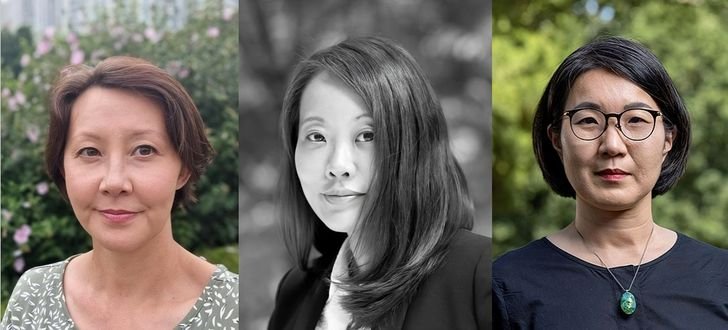
From left, Sora Kim-Russell, Krys Lee and Ji-Eun Lee, the judges for The Korea Times’ 57th Modern Korean Literature Translation Awards / Courtesy of Sora Kim-Russell, Krys Lee and Ji-Eun Lee
The Korea Times’ 57th Modern Korean Literature Translation Awards entries demonstrate the growing range of voices and talent within the world of Korean literature, and the translators who, with their passion, commitment and creativity, bring these voices to life for a greater reading public.
Our discussions focused on how to balance the choices that a translator made, from larger decisions to finer details. We gave serious consideration to the translator’s selection of which texts to translate, both in terms of selecting more challenging texts, as well as texts that we considered to have greater literary merit within their genre. When it came to our final candidates, we considered more closely the translator’s ear for the music of the target language, the fluency of the translation ranging from phrasing, tone, diction and general grammatical structure of sentences, and in the case of poetry, other specific elements such as line breaks. We also weighed each text’s themes and social concerns, in terms of how the texts might reflect the unique nature of a translation award focused on Korean literature.
The translators for this year’s award made adventurous choices in the selection of texts, and we were delighted to see historical and mythic fiction, as well as experimental poetry. While some translations did not hold up as well under scrutiny, we agreed that many were nonetheless excellent translations that would have benefited from a touch more revision. We agreed, too, that conferring a translation award is not necessarily the best indication of publishability: the judges can choose only a strictly limited number of recipients from among many worthy entries.
We did observe a tendency toward approaching poetry via a line-by-line translation, sometimes resorting to a proliferation of conjunctions or em dashes to manage longer sentences, or shortening and simplifying them. While we appreciated the effort to faithfully recreate the line structure of the original poems, sometimes the results tended to fall short of the lyricism of the originals. Thus, we tended to give greater weight to the translations that evinced an effort to grapple with what the poems are doing and to recreate their sound and sense in the target language. This also meant that we appreciated translations that attempted innovative solutions to difficult translation issues, and tried to bring to life the shifting energy, mood and voice of the original poems.
Grand Prize in fiction
We were unanimous in our choice of the short story “How to Get Your Deposit Back” by Cho Ye-eun for the Grand Prize in fiction. The story is an interesting selection in its balance of literary merit and the uneasy way it rides the boundaries of horror and realism that was both psychologically riveting and mysterious. Its subject of youth and the risk of losing one’s substantial security deposit, a social crisis in Korea that has made headlines in the last few years, was revealed in an engaging, surprising way. Though there is no such thing as a perfect translation, we felt that the kinds of choices a translator makes is what reveals both their strengths and weaknesses. Despite the overreliance on passive tense in moments of suspense, we appreciated how the translator captured the overall mood and complexity of the story.
Commendation Award in fiction
For the Commendation Award we selected “Bead by Bead” by Jeong Ji-a. We appreciated the story’s complexity and how the translation brought to life the way the original text engages readers with psychological insight and moving detail. The story’s focus on death reflects greater social concerns in Korean society as it faces a rapidly aging population, and the story handles it with great sensitivity. Choosing a story featuring the Jeolla Province dialect was a brave choice, but unfortunately the translator chose not to address this. We would have appreciated a clearer attempt at recognizing this on the page, if only to hear more of the narrator’s personality and add warmth to the conversations between the narrator and her daughter. Despite a few mistranslations, however, the translation captures the nuances of this emotionally complex story.
Commendation Awards in poetry
Evaluating the poetry translations was more challenging, due to the wide variation in difficulty and the number of entries that demonstrated both great strengths and notable flaws. We spent a great deal of time discussing our criteria and repeatedly reviewing the entries before we made our final decision. After much deliberation, we decided to select two Commendation Awards this year.
“There Was a Fire” by Ahn Hee-yeon were more difficult poems that were strong and engaging, and matched the translator’s style well. We admired how the translator made difficult decisions trying to recreate a sense of the original poems’ complexity rather than relying on a line-by-line translation or simplifying the poems. We did note an overreliance on the em dash and a tendency to replace enjambed grammar with full stops. Nevertheless, we wanted to give credit to the translator’s ambition and skill, along with their choice of text.
Poetry Commendation Award winner “Always Too Many Rains” by Lee Su-myeong initially felt a touch too simplified, but on closer examination, we appreciated how the translator sought to replicate the short, spare and fragmentary style of the original poems. If we had one quibble, it was that the translator maybe shied a bit too much from some of the poems’ strangeness. We appreciated how the translator sought to replicate the style and spirit of the original. The tendency to smooth out poems in the target language can result in a different voice and tone, and ultimately, a different poet, and we laud the translator for avoiding this temptation while also encouraging them to lean into it further.
Kevin O’Rourke Prize
We wanted to select a work attentive to language, whether it be fiction or poetry, in the spirit of writer and translator Kevin O’Rourke. This was perhaps the category we discussed most until our conversations ultimately concluded with the arresting short story “Giraffe Is the Name of the World” by Danyao. From the onset, we were entranced by its unique way of storytelling and world-building that teaches a reader how to read a story. Though perhaps not the most challenging to translate of the fiction entries, we were mesmerized by the beauty of the short story’s language and style, and how the translator managed to recreate the story’s tone and energy in the translation. In a time when Korea is experiencing a renaissance in science fiction, we were also delighted to recognize a translation in the genre.