












[ED] US midterms impact Korean indexes
 0
 0

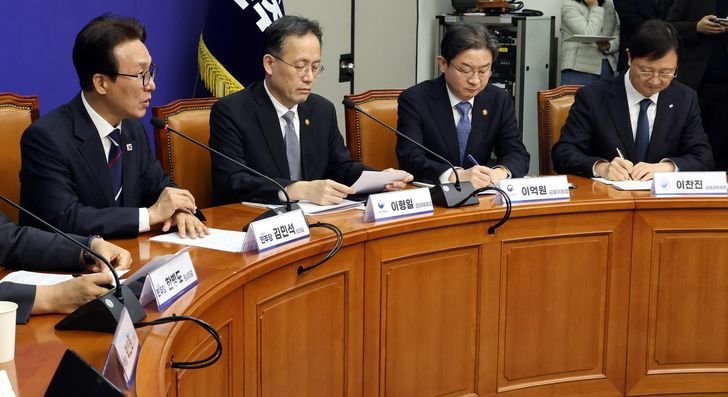
Rep. Kim Min-seok, left, chief of the ruling Democratic Party of Korea, speaks during a press conference at the National Assembly, Friday, to discuss stabilization of the financial market and investor protection. Also in attendance were Finance Minister Lee Hyoung-il, second from left, Financial Services Commission Chairman Lee Eog-weon, third from left, and Financial Supervisory Service Gov. Lee Chan-jin. Yonhap
The recent “Black Friday” for the Korean stock market brought a frantic mixture of a circuit breaker and sell-side sidecars as the main bourse fell more than 6 percent.
Benchmark KOSPI heavyweights SK hynix and Samsung Electronics also took a hit, with their shares falling 10.44 percent and 6.35 percent, respectively, as investors sold in panic, driving the index below 5,000 during trading.
Meanwhile, U.S. indexes that had risen immediately after last week’s midterm elections also fluctated. Investors and policymakers woke up to a changed economic climate, triggered by a shift in the U.S. political landscape.
Any optimism that last week’s U.S. midterm elections had reaffirmed the country’s democratic values was tempered by concerns over the Democrats’ agenda to regulate artificial intelligence (AI) and restrict data center construction. A deeper concern is that these policy shifts come amid growing skepticism over whether the AI boom is actually a bubble and whether massive investments in the sector will ultimately generate profits.
Other Asian stock markets, including Taiwan’s, also declined Friday. But Seoul’s heavy reliance on its semiconductor sector amplified market volatility, which was pushed up even higher by President Lee Jae Myung’s strong pledge to tackle the so-called “Korea discount.” In response to the sharp decline, senior officials from Korea’s economic, financial regulatory and monetary agencies convened to discuss emergency measures, including a three-month exemption from collateral reserve requirements on loans to investors in an effort to curb further selling.
The measure may for the time being bring some peace to investors, but they now depressed and distrustful are also likely to be wary of government measures. Aggressive investments in AI and a sustained drive in the U.S. to build data centers also contributed to the strong performance by Korea’s top chipmakers. But the market landscape has shifted, as has the balance of power in the U.S. Congress. The episode should prompt Korea and its financial authorities to pursue more fundamental reforms to guard against future market shocks.
Structural reforms take time, but with the Korean economy forecast to grow by around 3 percent this year, the country must use that momentum to diversify its economic base and reduce its vulnerability to external shocks.
We have repeatedly called for greater economic diversification, particularly to reduce the concentration of semiconductors in Korea’s exports and stock market. Exports of semiconductors including high-bandwidth memory and conventional memory chips are estimated to account for about 40 percent of the country’s total exports, which are on track to reach a record $1 trillion as early as this month.
SK hynix and Samsung Electronics also make up about 40 percent of KOSPI’s total market capitalization. This structure cannot continue to drive sustainable growth for Korea, nor can it produce the surplus profits that fill government coffers. At the same time, Korea cannot afford to lose its competitive edge in semiconductors and must continue investing in research, development and innovation, as reflected in the government’s plans for three major semiconductor projects. The surplus profits from the current chip boom gave the government the confidence to pursue its “three megaprojects,” but it still needs future growth engines. Policymakers should focus on deregulation to revive the automotive, shipping and battery sectors, while fostering an environment for emerging sectors such as robotics, biotechnology and small modular reactors to become new engines of growth.
The Lee administration must devote greater attention to these structural economic challenges and their long-term implications for the country, rather than concentrating so heavily on domestic political battles, including the recent passage of a bill authorizing a special counsel investigation into allegations of fabricated indictments targeting the president and others.