




[COVER STORY] Ruling party leader’s credibility put on line as Shincheonji claims backfire
 0
 0

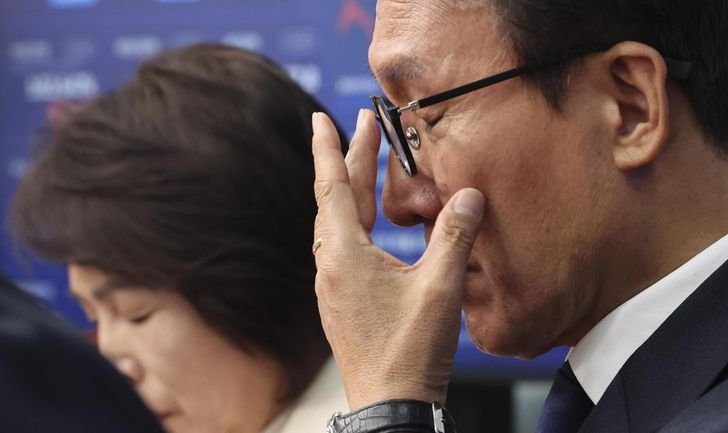
Kim Min-seok, chairman of the ruling Democratic Party, adjusts his glasses during a Supreme Council meeting at the National Assembly in Seoul, Friday. Newsis
Kim Min-seok, chairman of the ruling Democratic Party of Korea (DPK) and former prime minister, is facing a test of his credibility after an internal investigation failed to substantiate his claims of a “secret alliance” involving his leadership rival and the nonmainstream religious sect Shincheonji.
On Friday, Kim apologized again during the party’s Supreme Council meeting. It was his third apology over the controversy, following remarks at Tuesday’s closed-door meeting of party lawmakers and on the party’s YouTube channel on Thursday.
“I once again offer my apologies to everyone who was hurt as I raised serious concerns and warned about religious interference in politics during the party’s leadership election,” Kim said.
He was referring to his allegation in the run-up to the Aug. 17 party leadership election that the anti-President Lee Jae Myung faction within the party and Shincheonji had formed a secret alliance. The claim targeted the camp of his leadership rival, former Chairman Rep. Jung Chung-rae.
After raising the allegation and winning the leadership race, Kim commissioned an investigation into the claims. Although it was found that there are a considerable number of people suspected of being Shincheonji followers, that finding alone did not show their membership was linked to the faction backing Jung.
Kim’s latest apology did little to satisfy Jung’s allies, who demanded a direct apology to those targeted and concrete steps toward accountability.
The reversal leaves Kim facing a problem larger than an insufficient apology. Having raised a serious accusation against Jung, a leading figure in a major party faction, and commissioned the investigation, Kim now faces pressure to explain the basis for his claims — and why the findings are not being released publicly.
Kim’s pledge to restore party unity may prove difficult to fulfill if his explanation raises more questions than it answers. Rather than settling the controversy, the handling of the findings could further deepen the factional divide.
The party began allowing sitting lawmakers and constituency committee heads to inspect the investigation report individually at the secretary-general’s office on Friday, with access available through Nov. 13. The materials will not be distributed separately.
That limited disclosure could become another flashpoint. If Jung’s allies conclude after reviewing the available findings that there is no evidence of the alleged alliance, they could intensify demands for Kim to take responsibility.
“This is clearly, to put it simply, a ticking time bomb,” Kim Sung-soo, a professor of political science at Hanyang University, told The Korea Times. “So his leadership has clearly suffered a devastating blow. And that, in my view, is probably why President Lee Jae Myung started a YouTube channel. Lee may have felt a sense of crisis — a concern that Kim’s leadership was no longer secure.”
The professor said restricting access to the findings would not prevent some lawmakers from leaking them, leaving the chairman vulnerable to further disclosures. Although he has retained his position as party leader for now, his actual authority had already been substantially weakened, he added.
The controversy could also extend beyond political accountability to a criminal investigation. Supreme Council member Lee Sung-yoon has called for an examination of whether Kim’s statements violated Article 52 of the Political Parties Act, which penalizes the publication of false statements in party leadership elections.
Under the provision covering false statements intended to prevent a candidate’s election, a conviction can carry up to five years in prison or a fine of 10 million won ($7,400).
The party chairman’s apologies and follow-up measures have not ended the backlash from Jung’s allies. Posts demanding Kim’s resignation have continued to appear in online communities frequented by Jung’s supporters.
Jung has also demanded that Kim publicly explain how he intends to take responsibility.
“Humiliating and confusing party members and exposing the party to grave risks constitutes an act against the party,” Jung wrote on social media. “He should also publicly state what responsibility he intends to take for that.”