












Democrats swept the midterms. Millions watched on livestreams with their favorite influencers
 0
 0

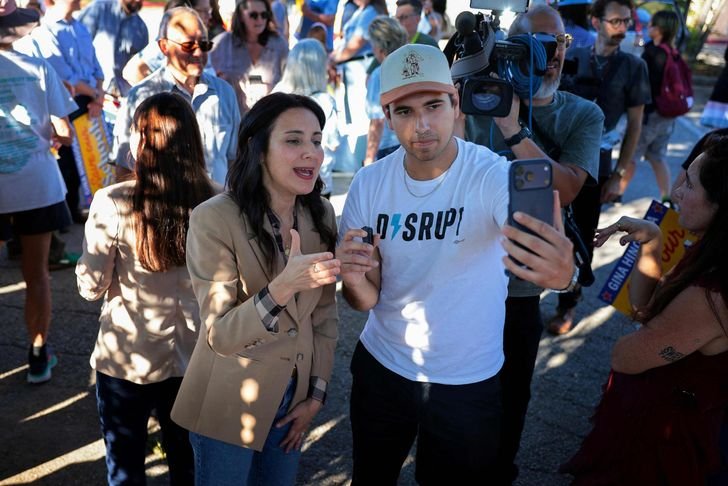
Texas Democratic gubernatorial candidate Gina Hinojosa speaks to an influencer during her a final public appearance before polls closed outside the Austin Recreation Center on Election Day, Tuesday, in Austin, Texas. Getty Images via AFP-Yonhap
The Democratic midterm sweep cemented a new front in the battle for media audiences: livestreaming, where left-leaning creators such as Hasan Piker are attracting viewers large enough to challenge established news outlets for attention.
Television networks have long dominated live election coverage, but as audiences increasingly turn to online creators to make sense of major news developments, media companies are trying to turn their broadcast talent into digital personalities.
That was on display Tuesday night when Comcast-owned NBC News launched the “Kornacki Cam,” a nearly 11-hour livestream featuring data guru Steve Kornacki. Blending detailed analysis of incoming results with behind-the-scenes footage, it drew 29 million views across platforms and peaked at more than 300,000 concurrent viewers for nearly three hours.
But some of the fiercest competition came from independent livestreamers, whose role in political coverage has grown over the past year. Chief among them was Piker, a self-described Marxist who has divided Democrats with remarks such as “America deserved 9/11.”
Abdul El-Sayed asked Piker to tone down his rhetoric after the streamer said Jews who supported Israel should be concerned for their safety, CNN reported. El-Sayed won Michigan’s Senate contest on Tuesday and is set to become the first Muslim senator.
The 35-year-old Piker drew a peak of 241,783 concurrent viewers to his election-night stream on Twitch, according to analytics platform Streams Charts. The stream drew 1.75 million hours of viewing, making it the second-most-watched individual broadcast after NBC News’ “Kornacki Cam.”
That was nearly three times the viewing of ABC News’ YouTube coverage and five times that of CBS News. Traditional television still commanded much larger broadcast audiences, however, with NBC averaging 6.8 million primetime viewers, ABC 5.1 million and Fox News about 4 million, according to Nielsen data.
“It’s hard to pick a singular label like 2024’s ‘podcast election’. But if there was one channel that really gained steam this election cycle, it was livestreaming,” said Jasmine Enberg, co-founder at creator economy-focused media startup Scalable.
In 2024, influencers helped reshape campaign media strategies as Donald Trump won a second presidential term, demonstrating how candidates could increasingly use digital personalities to reach voters beyond traditional broadcast audiences.
In the midterms, Democrats were outspent by Republicans on traditional advertising, but candidates including El-Sayed and James Talarico used digital videos to build audiences organically.
Election-related livestreams drew 10.27 million hours of viewing – equivalent to more than 1,170 years of continuous watching – across more than 2,500 channels in the 30 days leading up to the November 3 vote, according to Streams Charts.
Viewership was 4.5 times higher than ahead of the 2022 midterms, with Piker accounting for nearly 45 percent of total watch time. Right-wing podcaster Candace Owens drew a peak audience of 70,000 concurrent viewers, the data showed.
Piker’s growing political clout
Beyond El-Sayed, Piker campaigned with Minnesota congresswoman Ilhan Omar and backed progressive challengers including New York’s Claire Valdez and Darializa Avila Chevalier, who won congressional seats on Tuesday.
His growing clout also drew Republican attacks, with Michigan Senate candidate Mike Rogers using Piker’s 9/11 remarks against El-Sayed. California congressman Ro Khanna also appeared on Piker’s election-night stream, underscoring the streamer’s appeal to Democratic politicians seeking younger audiences.
That demographic is increasingly important. Some 38 percent of Americans aged 18 to 29 regularly get news from social media influencers, compared with 8 percent of those 65 and older, according to a 2025 Pew Research Center survey.
Still, experts are divided over whether political livestreamers can match the influence of podcasters such as Joe Rogan, who draw millions of viewers and listeners per episode, including many who might not otherwise engage with politics.
“It does seem clear that a lot of these streamers have become influential enough to become boogeymen for their opponents,” said Max Willens, principal analyst at Emarketer.
“If you wanted to put a finer point on it and ask me, is Hasan maybe one of the leading voices and most influential public figures for the far left in the political system, that’s probably true. But to say that he is in that kind of role for the capital-D Democratic Party, that’s a bridge too far.”