










Korea swaps drone command for smaller agency focused on development, procurement
 0
 0
Vice Defense Minister Lee Doo-hee, left, presents the unit flag to Kim Deuk-bong, chief of the Defense Drone Agency, during a ceremony marking its launch in Pocheon, Gyeonggi Province, Monday. Courtesy of Ministry of National Defense
South Korea has replaced its military drone operations command with a smaller agency focused on developing drone capabilities and speeding up procurement, shifting operational responsibilities to individual service branches.
The Ministry of National Defense held a ceremony Monday in Pocheon, Gyeonggi Province, to mark the launch of the Defense Drone Agency, which officially began operations Sunday.
The restructuring reduces the staff from about 280 at the former headquarters to 100 at the new agency, while increasing the proportion of personnel at the field-grade officer level or above from 17 percent to more than 50 percent. The new organization will focus on planning drone requirements, testing technology and helping the military acquire equipment more quickly.
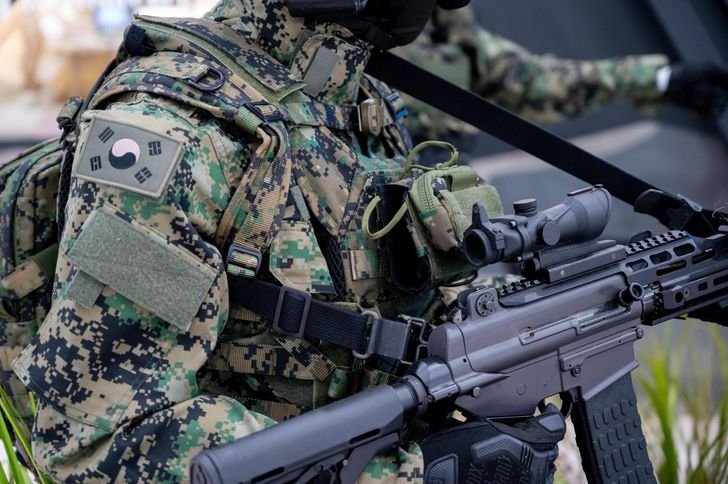
Unlike the former Drone Operations Command, which conducted missions using its own units, the new agency will not command combat operations. Its operational units and assets are being transferred to the Army, Air Force and Marine Corps.
Under the previous arrangement, the services primarily used drones for surveillance and reconnaissance, while the command concentrated on strikes. Each service will now handle both reconnaissance and strike missions, with the Joint Chiefs of Staff overseeing their integration into broader military operations.
Shin Jong-woo, secretary-general of the Korea Defense and Security Forum, said shifting drone operations to individual service branches made sense from a military perspective, but questioned whether the South Korean military had adequately learned the lessons of modern drone warfare.
“Drones clearly need to be operated at the different levels of the military,” Shin said. “But I question whether the South Korean military really understands modern drone warfare.”
He pointed to lessons from the wars in Ukraine and Iran, particularly the need to adapt drone and counter-drone tactics to modern combat.
“Drone strikes need to be integrated with other capabilities, including artillery and aircraft,” a defense ministry official said. “If drone operations are conducted separately, that integration becomes less effective.”
The official added that counter-drone operations also need to be integrated with existing air defense systems.
The ministry wants drones to become standard equipment across the armed forces rather than a capability concentrated in one command.
The new agency will draw on personnel experienced in drone operations, weapons planning and procurement. Its chief will retain the rank of major general, with the current drone operations commander serving as its first chief.
Despite its smaller size, the agency will coordinate drone development across the military. Individual services will continue to submit their own requirements, while the agency will review overlapping requests and work to standardize equipment and capabilities. The Joint Chiefs of Staff will retain final authority over requirements.
Soldiers from the Army’s TIGER unit demonstrate a manned-unmanned combat system near Gyeryongdae, Sept. 21, 2023. Courtesy of Kookbang Ilbo
Another key priority is addressing persistent delays in bringing new technology into service.
“We see delays in fielding advanced capabilities such as drones and artificial intelligence as a serious problem,” a defense ministry official said, citing procedures required under existing defense procurement law.
“Expendable drones require a different approach,” the official said, referring to the need to acquire inexpensive equipment more quickly than conventional weapons.
The ministry is pursuing separate legislation and a purchasing system modeled on the U.S. Blue UAS program to speed up the adoption of commercially developed drones.
Under the proposed system, commercially available drones that meet military standards could be certified for faster procurement. The agency will support testing and certification, while the Defense Acquisition Program Administration will remain responsible for purchase and contracts.
Shin questioned whether the military’s procurement practices could support the new approach.
“North Korea is racing to acquire drones, but our procurement process takes far too long, and we keep trying to equip drones with expensive systems,” he said.
He also criticized the military’s counter-drone preparations, citing protective cages fitted to armored vehicles during exercises.
“They’ve barely covered the roofs with cages,” Shin said. “In Ukraine, they’re covering entire tanks and armored vehicles with protective structures, and even those are being destroyed.”
“The biggest problem is that the military doesn’t understand modern drone warfare or how drones should be acquired,” he added.
The restructuring also comes as the military seeks to respond to North Korea’s expanding drone threat and apply lessons from the war in Ukraine.
The military plans to acquire more than 20,000 low-cost expendable drones, including short-range reconnaissance and small suicide drones, as part of efforts to expand drone capabilities across the armed forces.