










Gov’t tightens grip on illegal foreign delivery riders amid nearly 17-fold surge in cases
 0
 0

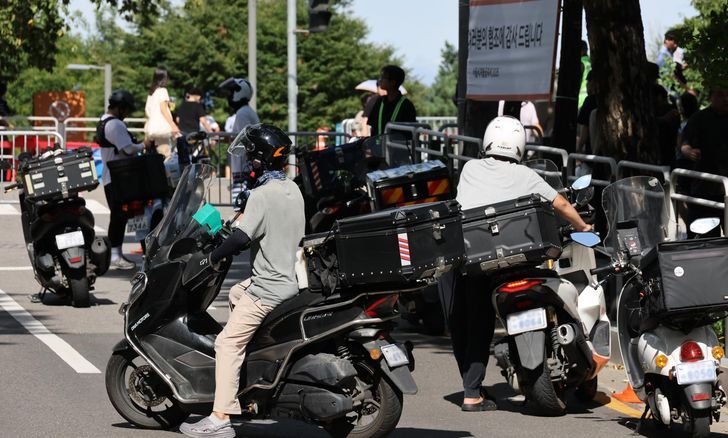
Delivery riders wait for customers who ordered food near Yeouido Hangang Park in Yeongdeungpo District, Seoul, Sept. 5. Yonhap
The government is moving to tighten enforcement against foreign delivery riders working illegally and the delivery company systems that let them slip through, amid a nearly 17-fold surge in the number of violators caught.
Last week, the Ministry of Justice said it held talks with the Ministry of Land, Infrastructure and Transport, the Ministry of Employment and Labor, the National Police Agency and the Korea Coast Guard on a joint government response to illegal delivery work by foreign nationals.
To root out the practice, the justice ministry plans to step up joint crackdowns with the police agency and expand cooperation in investigating related offenses, such as organized illegal hiring and brokering by delivery agencies, unlicensed driving and the unauthorized use of accounts registered under other people’s names.
The justice ministry also plans to work with relevant agencies to build an identity verification system for riders, improve systems for managing and inspecting delivery agencies and encourage the industry to prevent illegal practices.
The transport ministry is set to receive enforcement data on illegal employment and other violations from immigration authorities and take action against delivery platform operators and others subject to fines.
The Korea Immigration Service will tighten penalties for international students caught working illegally in restricted sectors such as delivery. In principle, they will face deportation or a departure order regardless of how many times they are caught.
Immigration offices nationwide plan to carry out intensive enforcement drives against immigration violators in 69 areas and workplaces with security concerns. They will also work with police and local governments to crack down on violations such as illegal paid transport and unlicensed driving, and step up joint patrols in crime-prone areas.
The measures come amid a sharp rise in foreign nationals caught working illegally in the delivery sector. Data released by Rep. Kim Gi-pyo of the Democratic Party of Korea at last month’s parliamentary audit showed that 1,132 foreign nationals were caught working illegally in the delivery sector from January to August this year, about 16.9 times more than the 67 caught throughout last year.
Only foreign nationals with certain visas, such as F-2 resident, F-5 permanent resident or F-6 marriage immigrant visas, can work in delivery. Student visa holders are barred even with part-time work permits.
Baemin, Korea’s largest food delivery platform, came under fire at the audit over its responsibility for managing accounts and partner companies.
Kim cited ads from some of Baemin’s delivery partners saying foreign nationals barred from delivery work could still work after a consultation and be paid under other people’s names. A delivery rider who appeared as a witness testified that others can use an account if its holder shares the verification number, pointing to loopholes in identity checks.
Meanwhile, the problem has also spilled over into tensions between foreign and Korean riders. Last month, a Korean delivery person received a suspended sentence on a fine for pushing a foreign delivery worker in Seoul’s Seongbuk District earlier this year, after suspecting him of using another person’s account.
The Korean confronted the foreign worker, asking why foreign nationals were doing delivery work. The foreign national had indeed been delivering under another person’s name at the time but was not in Korea illegally, according to investigators.