














‘Like Kashmir’: How a toxic marble dump yard became a tourist spot in India | Environment News
 0
 0
Kishangarh, India – As Bagharam Gurjar kneels to pull weeds from his maize field in western India’s Rajasthan state, the sound of his wife coughing nearby makes him restless.
“Everything gets ruined when dust settles on the soil,” says Gurjar, 53, barely looking up.
Recommended Stories
list of 4 itemsend of list
“May God make everything right,” replies his wife between bouts of chronic cough. “Otherwise, it becomes difficult to grow crops.”

The Gurjars are among nearly 5,000 people living in the vicinity of what has turned out to be one of the most unusual tourist destinations in India.
Their village, Bhogiyawas, is just 6km (4 miles) from Kishangarh, where a 300-acre (121-hectare) marble slurry dumping yard resembles a snow-clad landscape, attracting hundreds of tourists every day in an otherwise arid state.
Locally known as a “Snow Yard”, the landfill in Rajasthan’s Ajmer district is the largest of its kind in Asia. Its pristine white hills and slopes with water-filled pits provide a surreal backdrop for visitors, who get free entry to the site.
Newlyweds pose against the snowy backdrop or the blue artificial lake, while couples soon to get married organise pre-wedding photoshoots. Social media influencers throng the landfill to make reels. Music videos and movies are also frequently shot here.

“Everyone, right from my five-year-old niece to my mother, loves it very much. Their first impression was that this looks like Kashmir,” Salim Shahzada, a businessman from Uttar Pradesh state, told Al Jazeera, referring to Indian-administered Kashmir.
Shahzada said he had visited the place a couple of times and decided to bring his family along this time. But he had no idea about the health and environmental problems linked to the dumping yard.
“I do not have much knowledge about this place or its ill effects. I only know that this is where marble cutting waste is dumped and that the hill itself is made of this waste,” he said.

Kishangarh, a marble and granite hub, is home to nearly 1,200 processing units, with the total daily business estimated at more than 160 million rupees ($1.7m), providing jobs to about 25,000 people, according to the Federation of Indian Granite and Stone Industry.
Every day, nearly 1,000 tankers carry slurry from those units and empty roughly 5,500 tonnes of waste on the government-allotted dump site, which, for the people living nearby, has turned into a health hazard.
Gurjar said the yard has affected residents in at least six villages. “How many problems can I even tell you about? If there were just one or two, we could deal with them,” he said.
“But here, almost everything is going wrong because of the dumping yard. People like me are suffering from chest infections, dental problems and skin allergies. It does not matter whether they are children or elderly people; everyone is suffering.”
Gurjar said he and his wife are forced to take regular medicines for chest infections or skin problems.

Aditi Goyal, a general physician at Ajmer’s Ganga Narayan Hospital, said the residents of Kishangarh face several health risks, mainly respiratory and skin problems. She said the workers in the marble processing units are more vulnerable to chronic illnesses because of prolonged exposure to toxic dust.
“Over the last couple of years, cases of respiratory problems have increased significantly in this area because people are exposed to dust from the dumping yard,” Goyal told Al Jazeera.
“However, dust from industrial waste is not the only issue. People in Kishangarh, who are mostly farmers, also suffer from infections caused by dust coming from the soil,” she said, advising people to wear masks to protect themselves from dust.
The same dust settles on the fields, hardening the soil and making it difficult to grow crops.
A study led by Laxmi Kant Sharma, professor in the department of environmental science at the Central University of Rajasthan, found that the concentration of lead silicate in Kishangarh’s soil was several times higher than normal, indicating extreme contamination.
“Since the waste particles are smaller than 75 micrometres, they can spread far and wide, making the soil infertile,” the study said.

The study also found that the concentration of PM2.5 exceeds the limit of ambient air quality standards. “Several people may be suffering from silicosis. The government needs to take immediate action to prevent the situation from getting out of hand,” it said.
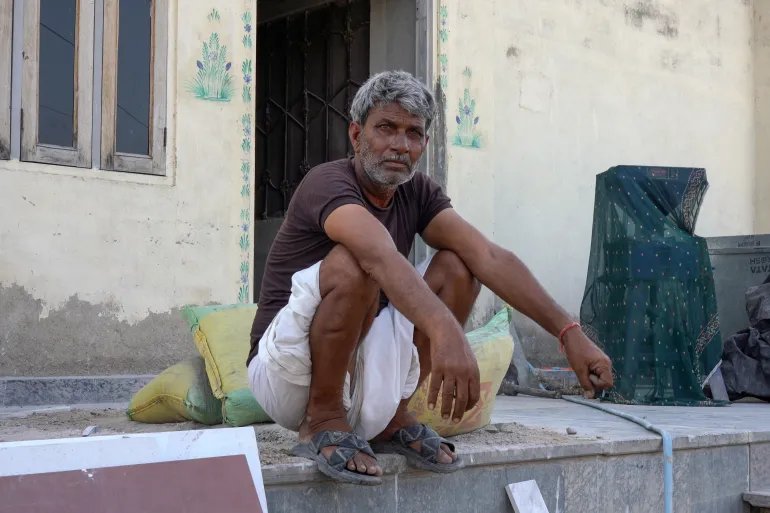
Ugam Singh, another resident of Bhogiyawas, remembers when things were different. The continuous dumping of slurry slowly changed the landscape and the lives of people in Kishangarh, says the 65-year-old.
“Nowadays, the situation has worsened to such an extent that even the groundwater is no longer fit for consumption,” Singh said.
“The fluoride levels in the water are so high that it tastes salty. My teeth have started decaying and my bones have become weak,” he added, pointing to his teeth, which appeared pale, pitted and worn.
Singh said the residents of villages surrounding the dump yard have complained to the authorities, including officials of the Rajasthan State Pollution Control Board (RSPCB). But their requests fell on deaf ears.
“What I have come to understand is that it does not matter which government is in power. No one listens to the poor. To make the rich richer, the government sacrifices the interests of people like us. It feels as though our lives have no value,” Singh said.
“Even today all we want is for this marble slurry dumping to stop so that we can breathe freely again and our fields can become green and productive once again.”

Singh also claims that if residents of all the villages around the dumping yard were properly examined, almost every household would have someone suffering from respiratory problems such as asthma.
Last year, local environmentalist Drupad Malik filed a case before the National Green Tribunal over the harmful health and environmental effects of the Kishangarh dumping yard. The tribunal observed that unregulated dumping of marble slurry was contaminating groundwater and air. It directed the RSPCB to enforce monitoring, conduct sample inspections and penalise the marble processing units violating environmental norms.
Al Jazeera reached out to a senior official at the RSPCB’s regional office in Kishangarh, but she refused to speak on the matter.
Central University’s Sharma said the areas surrounding the Kishangarh dumping yard are unfit for human settlement. He said his research was shared with state authorities, but nothing was done to improve the environmental conditions in the area.
“There is a dire need to shift the dumping yard to another place where there is no human contact. This area has become extremely toxic and vulnerable to severe diseases. I am surprised that people are allowed to visit the site without masks and even have food there,” Sharma told Al Jazeera.
“I have forwarded several suggestions, including installing tile units, as [marble] slurry is used in tile manufacturing. This could, to some extent, help reduce pollution in Kishangarh,” he added.
Meanwhile, Ram Lal, a resident of Tokra village, about a 15-minute drive from Bhogiyawas, appealed to the government to find an alternative site for dumping the marble slurry.
“Kishangarh is full of slurry, and it is time to shift the dumping yard out of here to some other place where no one will suffer for at least two to three decades,” Lal told Al Jazeera.
“We also demand that free medical camps be set up to assess people whose health has declined because of the fine dust particles that have been flying in the air and settling here for years,” he said.
“No one from our village can afford it if someone develops a disease that costs thousands of rupees to treat.”