













Chip-led growth, AI erode youth job quality: BOK
 0
 0

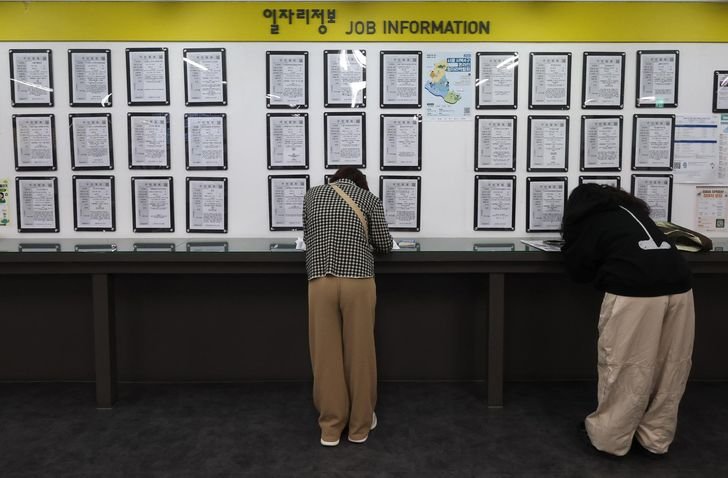
People browse job listings at an employment welfare center operated by the Ministry of Employment and Labor in Mapo District, Seoul, Oct. 19. Yonhap
Korea’s reliance on semiconductor-driven growth, the accelerating spread of artificial intelligence (AI) and inflexible labor market institutions are weakening the quality of jobs available to young people, the Bank of Korea (BOK) said Monday.
As economic growth fails to generate enough stable employment opportunities, more young job seekers are accepting temporary or daily work instead of holding out for regular positions.
In its analysis of workers aged 15 to 29, the central bank classified regular employment as the primary labor market, and temporary and daily work as the secondary market. Since 2023, young people have shown a growing tendency to enter the latter, adjusting their expectations as hiring in the primary market remains sluggish.
The report linked this deterioration to a combination of changes in the industrial landscape, advances in AI and rigid employment arrangements.
One problem is the growing mismatch between the sectors powering the economy and those providing regular employment.
Information technology (IT) manufacturing has become a stronger driver of growth but generates relatively few regular jobs. Most hiring for such positions still takes place in non-IT manufacturing and services.
“This disconnect has prevented economic expansion from translating into increased demand for regular workers,” the central bank said. “The resulting pressure has been concentrated among young people entering the workforce, rather than spread evenly across age groups.”
Generative AI’s rapid adoption since late 2022 has added to those difficulties.
In industries highly exposed to AI, including finance, insurance and professional, scientific and technical services, companies increasingly favor experienced hires as demand for the basic and entry-level tasks traditionally assigned to younger staff declines.
The report also cited strong protections for incumbent employees as a potential barrier to new entrants.
Korea placed 10th among 23 major economies on the OECD’s measure of protection against individual dismissal for regular workers. Stronger employment safeguards generally coincide with lower youth employment rates, according to the BOK.
“Addressing these challenges requires coordinated changes to industrial policy and labor market structures,” the bank said. “Measures aimed solely at improving labor supply would be insufficient to resolve the underlying problems.”
It urged policymakers to help growth in IT manufacturing benefit related industries and the domestic economy, while bringing education and industry into closer alignment to meet the workforce needs of a chip-led economy and the AI era.
The BOK also recommended greater flexibility in employment rules to make it easier for young people to find work and move between jobs.