










The French government is hiding behind a ‘riots’ narrative | Protests
 0
 0
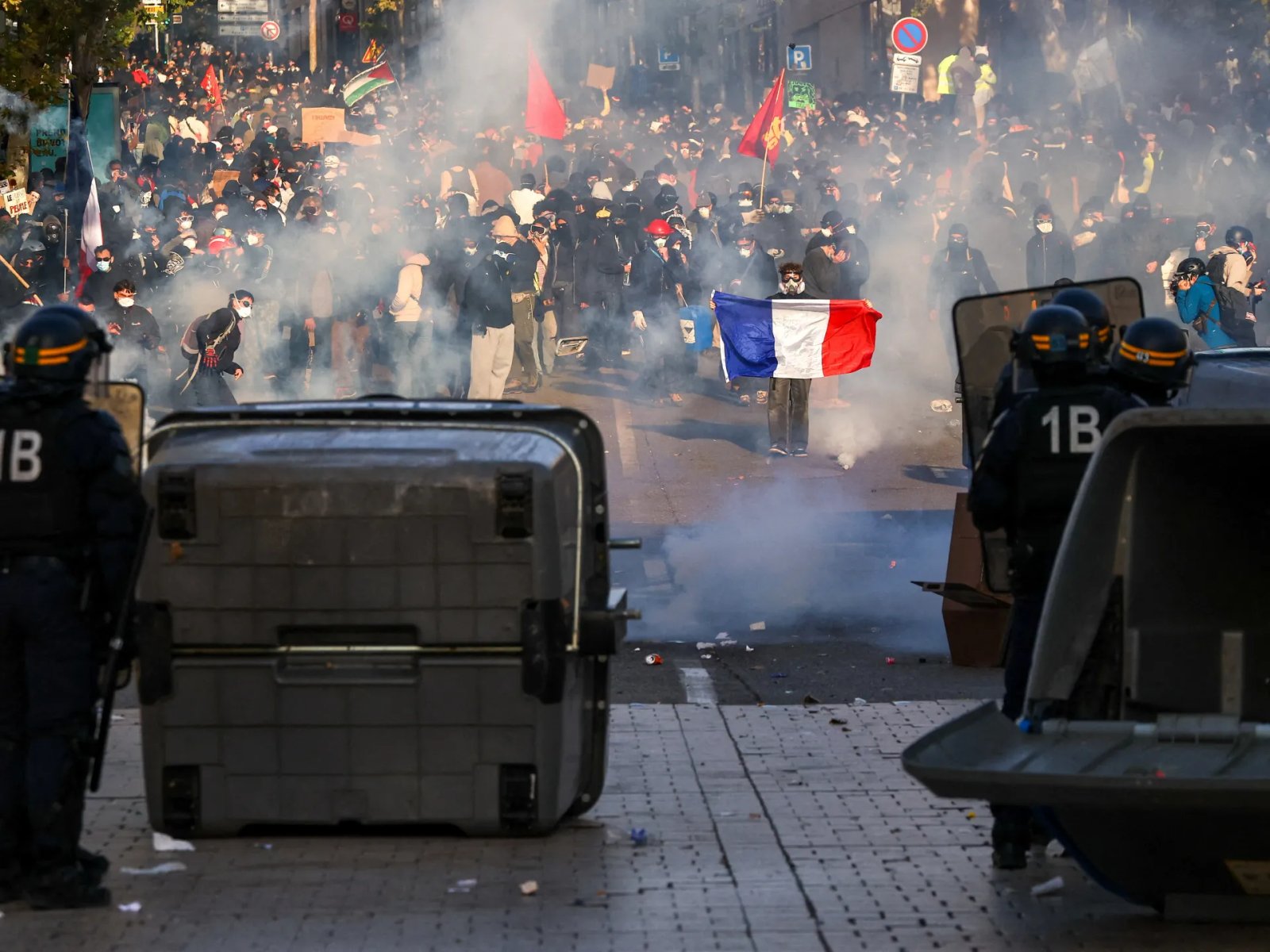
Images from the violent unrest in France have travelled around the world. Smashed shop windows, destroyed property, acts of looting and raging fires have rightly caused outrage and condemnation.
There is no single explanation of the motives of the perpetrators. There are certainly opportunistic “criminal elements” who take advantage of such situations. But there is also a lot of public anger that has boiled over after it had simmered for years as living conditions have deteriorated and demands for changes have been left unanswered.
The French government has taken full advantage of these violent acts, using them to justify the overly securitised response to the protests and to avoid public scrutiny for the failure to address its own failures. The images of chaos allow those in power to pose as the defenders of a public order they have actively helped undermine.
These acts of violence, however, cannot delegitimise the reasons behind the mass mobilisation of students across France. They also must not distract from the brutal police violence that has unfolded.
Fourteen-year-old Eden suffered a fractured jaw and had teeth knocked out by a tear gas grenade fired from a police launcher. Sixteen-year-old Mael lost the sight in one eye after a suspected hit from a police rubber bullet. Fifteen-year-old Evan had a hand blown off by a police stun grenade.
By October 14, 7,950 people had been placed in police custody since the protests began in September, 85 percent of them minors. A further 2,700 were taken into custody following the October 17 protests. Yesterday, police made another 1,000 arrests.
The staggering scale of detention and the mobilisation of tens of thousands of police officers make this one of the most heavily repressed protest movements of this century.
But there is also the quieter violence of social deprivation that the students are protesting and that has largely been ignored in the public narrative.
Across France, the sense of growing impoverishment deepens year after year. Poverty rates are the highest they have been since the 1990s, with 9.8 million people living under the official poverty line. Meanwhile, 53 French billionaires own as much wealth as nearly half of the French population, according to Oxfam.
Deteriorating socioeconomic conditions have hit the French educational system hard.
In Acoua, on the island of Mayotte, the Cite du Nord secondary school was blockaded as early as August 31. Long before protests in the Paris region attracted attention, parents and staff came out in protest to demand better learning and teaching conditions.
Built for 900 pupils, this school accommodates 2,300 in cramped, poorly ventilated classrooms. Alongside staff shortages, the school also struggles with water supply failures and unsanitary conditions in toilets.
In Sevran, a suburb of Paris, pupils and teachers at Blaise-Cendrars secondary school have complained since 2024 about water leaks, mould, unusable toilets, and shortages of tables and chairs.
At Marcelin-Berthelot secondary school in Pantin, another Parisian suburb, windows no longer open at a time when heatwaves can bring temperatures as high as 40C.
At Politzer secondary school in Bagnolet, also a Parisian suburb, staff, pupils and parents learnt in late September that the water was unsafe to drink, although it had been tested in June.
These are just a few examples of a countrywide trend of an educational infrastructure that is fast deteriorating, especially in impoverished areas.
This is compounded by the erosion of the level of education pupils actually receive. According to the education ministry’s own figures, 20.2 million teaching hours were not delivered in state secondary schools in 2024–25, excluding Mayotte: almost one in 10 scheduled hours. Of these, 15 million were lost because absent teachers were not replaced.
According to French economist Lucas Chancel, since 2017, when Emmanuel Macron came to power, government spending per student has declined by 20 percent.
This is the structural violence French students are asking those in power to end. Instead of listening, the government has responded with repressive tactics and narrative spin.
In his address to the public, Macron said he understood the students, but he did not express support for them the way he did for police officers. A meeting with 20 students on Friday resulted in a promise to reform the university entrance platform – not to address the students’ key demands.
Macron has doubled down on the security “solution”, deploying 70,000 police officers and pledging to ban protests. He has accused the “far left” of seeking to “bring down the republic”.
Meanwhile, Prime Minister Sebastien Lecornu has called on the left to “choose a side”: the Republic equated with the police, or the rioters and their “violent agenda”. As if taking part in a protest amounted to an attack on the state.
Unsurprisingly, the far right is revelling in the chaos that appears to be engulfing the country, obscuring these needs by focusing on the presumed origins of people filmed committing acts of violence. Some far-right politicians have denounced the “hordes of thugs of foreign origin”, others have called for broader powers to strip people of their citizenship.
This rhetoric serves Macron’s political camp well as it allows it to present itself once again as the last defence against the far right, asking the general population to rally behind out of fear rather than because of its governance record. Voters are offered an increasingly bleak choice between those who have fuelled their anger and those seeking to turn it into racial hatred.
At this point, it is clear the government does not seem interested in genuinely addressing the demands of the students is in the cards. Doing so would mean confronting the priorities of Macron’s presidency: protecting the wealth of the few and abandoning the many.
Instead, the government will wait for the movement to exhaust itself, be weakened by fear or be discredited by unrest, until it dies out on its own.
This strategy, however, is a failed one. Even if this protest movement fizzles out, a new one will soon replace it. The French people cannot be scared into complacency forever while their living conditions continue to deteriorate.
The views expressed in this article are the author’s own and do not necessarily reflect Al Jazeera’s editorial stance.