

EU sees Korea as ‘trusted partner’ in evolving Indo-Pacific strategy
 0
 0

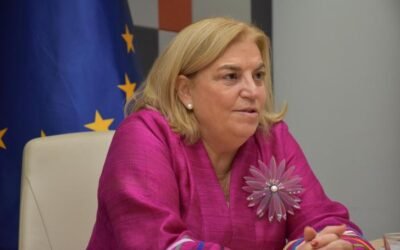
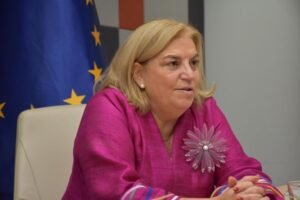
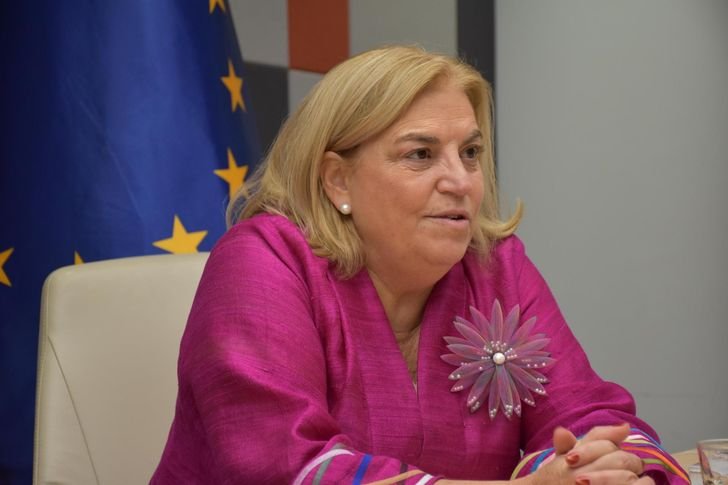
Maria Castillo Fernandez, the European Union’s special envoy for the Indo-Pacific, speaks during an interview with The Korea Times at the EU Delegation in Seoul, Thursday. Courtesy of the Delegation of the European Union to Korea
The European Union (EU) has sharpened its Indo-Pacific strategy around three core priorities — security, economic security and climate action — as geopolitical tensions reshape the bloc’s approach to the region, according to the EU special envoy.
Maria Castillo Fernandez, European External Action Service’s Special Envoy of the European Union for the Indo-Pacific, said the EU’s Indo-Pacific strategy, launched in 2021, initially covered a broad range of areas but has since grown more focused in response to a changing security landscape.
“Security in Europe is interconnected to what is happening on security in the Indo-Pacific,” she said, pointing to military cooperation between Russia, China and North Korea. The first pillar also includes maritime security, freedom of navigation and protection of critical maritime infrastructure from hybrid threats — concerns that have grown more urgent following recent tensions in the Strait of Hormuz, a vital chokepoint through which a significant share of the world’s oil and liquefied natural gas passes.
The second pillar is economic security. “It is important to access raw materials in a reliable and sustainable way to maintain the supply chains’ resilience,” she said. For this, the EU has been expanding its free trade agreement network and partnerships in digital technologies and critical raw materials.
The third pillar focuses on the climate agenda, closely linked to the blue economy, which refers to the range of economic activities associated with the oceans and seas. Small island nations in the Pacific are particularly vulnerable to climate change, while many countries in the Indian Ocean face the threat of losing parts of their territory due to rising sea levels.
“Climate agenda is linked to ocean governance, to maritime resources management (and) to all the very strong climate crisis,” added Castillo Fernandez.
Calling on Korea over Ukraine issue
Castillo Fernandez called Korea a “trusted partner,” saying there is significant potential for the EU to deepen cooperation with Korea across the three pillars.
“Korea is a partner that respects the rule of law and a rules-based international order,” she said.
Her experience serving as the EU ambassador to Korea for around five years until August 2025 has helped her broaden cooperation with other countries, as Korea has already set a clear example of how stronger partnerships can be built.
“Korea was certainly one of the examples of things we can do for stronger partnerships in the Indo-Pacific.”
However, she also highlighted areas where Korea could play a greater role, particularly in security.
“Whatever happens in Ukraine is very important for us,” she said. “We are always grateful to our closest partners who have been following our sanctions and supporting Ukraine as much as they could.”
With winter approaching and Russia continuing to bombard Ukraine’s energy infrastructure on a daily basis, Castillo Fernandez called for continued support, stressing that helping Ukraine means helping Europe.
“I’ve seen Korea has put efforts on Ukraine on the humanitarian side and that has helped to alleviate the difficulties of the Ukrainian people. So whatever they can do is welcome.”
Given that the war in Ukraine is also causing all of Europe to suffer an energy crisis, the special envoy underscored the importance of further cooperation in energy, particularly in making it more affordable for households and strengthening electricity grids to accommodate the growing use of renewable energy sources, including solar and wind power.
Against weaponization of trade
Against the growing trade tensions and the Trump administration’s tariff policies, Castillo Fernandez stressed the need to uphold the rules-based international trading system.
“Korea and the EU are both speaking out against the weaponization of trade,” she said, while underlining that necessary reforms should be made in a way that respects the established international trade rules under the World Trade Organization.
She also underscored the importance of honoring existing free trade agreements rather than imposing new tariffs unilaterally, an apparent reference to the U.S. Donald Trump administration’s tariff measures. Pointing to the newly established Korea-EU Competitiveness Partnership that was made during Korea-EU summit held in Brussels in June, she said the initiative would serve as a platform for regular consultations on emerging trade and economic security challenges.
Since Korea is a technological leader, the special envoy believes its expertise could benefit the broader Indo-Pacific region. The EU is already in discussions with Korean development agencies on potential joint projects in third countries across the Indo-Pacific region, she said.
“We can complement each other’s efforts in supporting less developed countries and work together on digitalization, forestry management and the transition to a low-carbon economy,” she said.
Looking ahead, Castillo Fernandez stressed that the strong ties between Korea and the EU should never be taken for granted, emphasizing that sustaining the partnership requires continued commitment from both sides.
“It requires a lot of will and efforts. We are maintaining it, and we are doing it now,” she said.