



Top US envoy cites ‘turbulence’ in S. Korea-US alliance amid rift in security, trade priorities
 0
 0

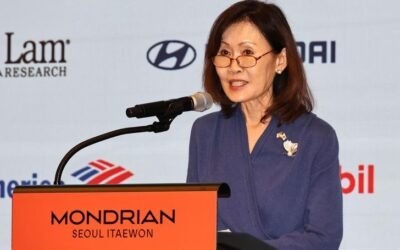
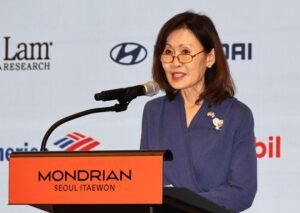
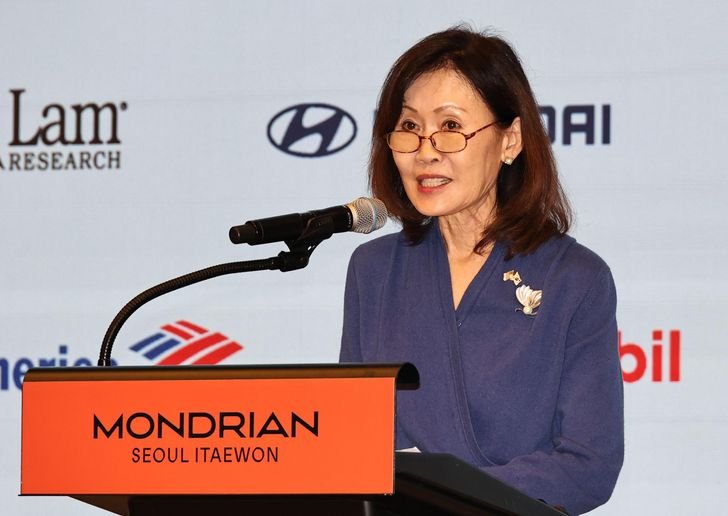
U.S. Ambassador to South Korea Michelle Steel delivers remarks during an event hosted by the American Chamber of Commerce in Korea (AMCHAM) at a hotel, Itaewon, Seoul, Wednesday. Yonhap
The top U.S. envoy to South Korea on Wednesday described bilateral relations between Seoul and Washington as being in a state of “turbulence,” stressing efforts to move the alliance forward into a stronger and more equal partnership.
U.S. Ambassador Michelle Steel’s remarks come amid apparent friction in the security and trade ties, from implementing their summit agreement from last October and intelligence sharing on North Korea to Seoul’s push to retake wartime operational control (OPCON) from Washington.
“This is, kind of, like a turbulence that we are going through between the Republic of Korea and the U.S.,” she said during a dialogue session hosted by the American Chamber of Commerce in Korea (AMCHAM), referring to South Korea by its official name.
“An alliance does not mean it stays always the same. It can be weaker, and we can move forward to be stronger. This is exactly what we are working on,” she said.
Seoul and Washington have agreed on a series of economic and security commitments, including nuclear energy, shipbuilding cooperation and South Korean investment in the U.S., following their leaders’ summit in October last year.
However, they have made slow progress in implementing the deals, as issues like Seoul’s legal scrutiny over U.S.-listed e-commerce giant Coupang Inc. have emerged as a key sticking point hampering momentum in the broader relationship.
Washington has also scaled back intelligence sharing on North Korea with Seoul in a pushback against South Korea’s unification minister disclosing a confidential North Korean nuclear facility.
The OPCON transfer remains an area where the allies have shown differences over the timing of the transition.
“So this working partnership between the U.S. and the Republic of Korea is the most important part,” Steel said.
Addressing U.S. concerns over South Korea’s regulatory policy affecting U.S. companies like Coupang, the ambassador strongly called on Seoul to ensure fair and equal treatment.
“American companies in Korea deserve to compete on a level playing field, fairly and without discrimination,” she said in her opening remarks.
While speaking on the panel, she also noted that the summit agreement, known as the joint fact sheet, states fair treatment for these companies.
“They have raided these companies, and they have audited these companies,” she said. “Hopefully, it is getting better; I heard it was getting better since we signed the joint fact sheet.”
Steel also said South Korea is no longer a country that needs U.S. protection, citing its remarkable economic growth since the 1950-53 Korean War, and called on the ally to take a more leading role alongside the U.S. in the Indo-Pacific region.
“Now it’s time to stand up and lead together with the United States and lead the Indo-Pacific region. South Korea’s economy grew so much,” she noted.
Her remarks appeared to echo the Donald Trump administration’s regional strategy, which centers on curbing an increasingly assertive China.