






High-profile US figures warn of evolving threats as OPCON transfer dispute simmers
 0
 0

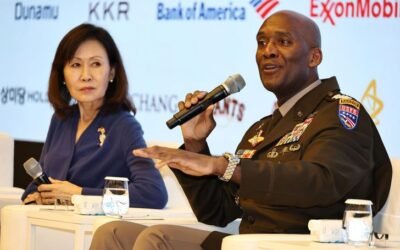
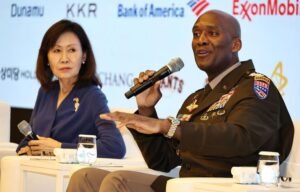
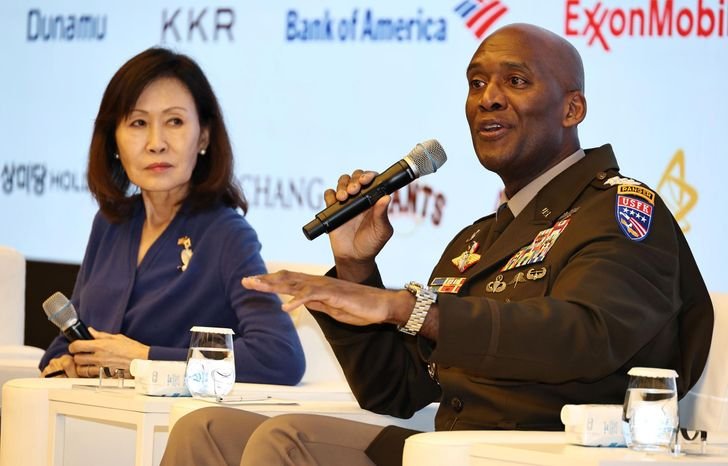
U.S. Forces Korea Commander Gen. Xavier Brunson, right, speaks during an American Chamber of Commerce in Korea (AMCHAM)-hosted uncheon at a hotel in Seoul, Wednesday. On the left is U.S. Ambassador to South Korea Michelle Park Steel. The two were the featured speakers at the event, attended by Korean and American business leaders. Yonhap
The Korean Peninsula faces a rapidly evolving threat environment, U.S. Forces Korea (USFK) Commander Gen. Xavier Brunson and a senior U.S. official said in back-to-back warnings from Seoul and Washington, raising questions about how those changes could affect the timing of the transfer of wartime operational control (OPCON).
Their remarks followed a renewed dispute over the OPCON transfer after Brunson suggested on Oct. 14 that evolving threats called for new transition standards, drawing objections from Seoul’s defense ministry and an unusual response from President Lee Jae Myung.
“Our security environment is not standing still. We see continued DPRK use of ballistic and cruise missiles and their advancements,” Brunson said Wednesday at a luncheon hosted by the American Chamber of Commerce in Korea (AMCHAM), using the acronym for North Korea’s official name.
Brunson and U.S. Ambassador to South Korea Michelle Park Steel were the featured speakers at the event, attended by Korean and American business leaders.
Held to commemorate the 250th anniversary of the U.S., the program explored the alliance’s security, economic and strategic dimensions and opportunities for closer cooperation.
“We see dangerous, deepening defense cooperation between Pyongyang and Moscow, and we see persistent gray zone activities intended to test our resolve and challenge regional stability,” the USFK commander added.
Brunson did not address the OPCON transfer criteria or other recent controversies concerning the Demilitarized Zone (DMZ) during the luncheon.
A day earlier in Washington, a senior U.S. official said the agreed requirements for the OPCON transfer remain unchanged despite the evolving threat environment.
“The fundamental requirements for OPCON transfer have not changed. But the threat environment is evolving faster now than ever before,” the official said condition of anonymity.
“Together, we must be prepared to deter and defeat all regional threats to the alliance,” the official added.
The Pentagon separately reaffirmed that the handover remains a conditions-based process mutually agreed upon by Seoul and Washington.
“Both nations remain committed to ensuring that the necessary conditions are met before any transition occurs. We will not prejudge decisions or outcomes of this bilateral process,” a Pentagon official said.
At the AMCHAM event, Brunson stressed that the alliance’s mission remains firm despite the shifting security landscape.
“Against that shifting picture, our mission remains immovable: to defend the Republic of Korea, to maintain the armistice,” he said.
The USFK commander also emphasized supporting South Korea, maintaining combined readiness and ensuring both countries’ security.
Brunson said USFK’s training on the Korean Peninsula would change to address new challenges, requiring the allies to train and exercise together.
Addressing industry leaders, Brunson emphasized the people and industrial capabilities underpinning the alliance.
“Credible deterrence does not begin and end with a platform,” he said. “I think it’s built on people, and it’s sustained by the industrial and technological foundation that stands behind it.”
He urged closer integration of production, maintenance and supply chains, citing Korean shipyards’ ability to repair U.S. naval vessels and return them to operations quickly.
The gathering took place as the allies manage differences over trade and business conditions alongside the OPCON dispute.
Steel called for improvements to Seoul’s business environment, saying, “American companies in Korea deserve to compete on a level playing field fairly and without discrimination.”
The comment was widely seen as a reference to Coupang, a U.S. e-commerce company that has faced investigation and discipline over a massive customer data breach disclosed late last year. Disagreements over the issue have fueled diplomatic friction between the two countries.
Steel said her embassy team works daily to improve operating conditions and remains open to discussions.
“You cannot separate prosperity and security,” Steel said. “Security makes prosperity possible, and prosperity makes us more secure.”
AMCHAM Chairman James Kim likewise said economic security and national security are now inseparable.